By a St Kilda Elder
Having lived in St Kilda south for over 40 years, I have had numerous encounters with the homeless, or as the more woke amongst us say, “people experiencing homelessness”. Some rather pleasant - like when Rebecca stopped me in the Woollies carpark and offered me a bundy and coke if I would give her a cigarette. It was 8am so she was on her own with the bundy, but we had a fag together and talked about her life- she had once had a car but had lost it. She didn’t mention drugs but admitted she loved her booze. She quite liked the Acland Street area and told me most locals were kind and generous. Rebecca is probably in her late 30s, not unattractive and was articulate and easy to talk with, at least that day she was. Other times when I've greeted her by name, she has actually scared me. So there is clearly a mental health issue going on. Last week I saw her in the entry to the Coles arcade and asked her how she was coping with the cold and if she needed a warm jacket. She was a bit distracted but said she was ok.
My latest strategy with folk sitting outside the supermarkets asking for change, ( we probably cannot say begging ) is to ask if they are hungry or thirsty before I go in to shop, Then I can offer a juice or a serve of hot chicken on my way out. On occasion, in a fit of generosity or middle-class guilt, I have handed over $50. I stopped giving cash after I saw one large middle-aged man, sprawled in a doorway, throw the couple of $2 coins back at a lady who had deposited them on his hanky, screaming at her “that won’t even buy me a cuppa coffee!!”
Today on the ramp to Woollies I met Dale, a young man who would once have been considered handsome. This morning though, he had sores on his face and his forehead was bleeding. When I inquired, he told me they had fallen on his face onto concrete. I asked whether he was hungry and handed him $10 saying he could choose what he wanted to eat and if I could ask him couple questions. He is a regular on the ramp and I asked whether he considered himself homeless. He told me he had no-one, no family, no home. He told me he uses ice and showed me a nasty looking sore on his arm. He said if he can get the money, he sometimes stays in hotels for about $100. I asked him about money, and he said he gets regular money from the State Trustees, put there by his mother. I presume she made this arrangement before she died, to ensure he didn’t blow the lot on ice. When I said - oh gosh, ice is a really bad drug, isn’t it? he smiled for the first time and said - nah, I love it… feels good.
As we talked a bloke came down the ramp and handed Dale a small can of coke and a large bag of potato chips. He stuffed a handful in his mouth and almost immediately started coughing and gasping and muttered something about having been exposed to a gas leak down in Port Melbourne. The coughing fit continued, and I joked about me doing the Heimlich manoeuvre to help him. Then he turned nasty - telling me I was trying to make him talk while he was hungry and wanted to eat the chips. He was still coughing and blaming the gas leak and I suggested he have a sip of the drink. He got nastier and told me in no uncertain terms to bugger off. As I left I urged him to buy something a bit healthier with the ten bucks.
I feel over-whelming compassion for people sleeping rough but, what the hell can we do to alleviate this issue of people sleeping rough, begging outside shops and doing hard and dangerous drugs. According to the Security Guard at Acland Court, it used to be much worse some years ago. He said the gates to the court are locked at midnight, but he sees the occasional person in the doorways. The 'concrete garden’ at the end of Acland Street seems to attract groups of what might be called people 'without purpose'. Once I made biscuits and tried to hand them round to a few groups but had not many takers.
Many residents do feel apprehension and fear having to step over sleeping bodies on the streets of Port Phillip. I understand that some areas have become like open air drug camps. In summer I guess that is. There is verbal abuse and even my acquaintance Rebecca has charged at me screaming. The harm minimisation approach does seem to have created another industry of despair. Is providing food and blankets and social workers and clothes washing service and turning a blind eye to hard drug use going to heal these people? Help them get out of the vicious cycle of drug use and homelessness and more drug use…? Will drug decriminalisation and a safe injecting room make Port Phillip proud and productive?
I don’t know the answers - but homeless hotspots around the world are coming to the end of their progressive tethers. San Francisco residents are so sick of dodging human faeces on the sidewalks that they are reassessing their approach. They are wanting more prosecutions of the open use of hard drugs and petty crime like shoplifting. In Europe some countries require those seeking social benefits to attend drug or alcohol treatment centres or get help for mental illness. It was publicised in January this year that: “Port Phillip becomes the first Australian community to measurably reduce rough sleeping”. This was seen as a "key milestone on the path to reaching functional zero.” Data had been collated and stakeholders consulted, and money spent. I do wonder how much of our rates is spent on tackling these problems. And whether the drop in homeless numbers had a lot to do with Covid funds providing hotel accommodation. Still the challenge of too little affordable housing remains.
I was quite excited to see a recent item on the ABC news site, about Noosa Council considering an application by a builder, Greg Phipps, to build dozens of tiny modular homes to provide affordable housing in Cooroy, which will be self-sustainable - meaning no bills for residents. Good onya Greg! A great idea. Now where on earth could Port Phillip place dozens of tiny homes for the needy? Oh I know - Elsternwick Park! We must already have some equity in that improvement project, having kicked in hundreds of thousands…

By Ron B
I thought our old wooden cottage at our family country property could potentially burn down each and every fire season. I thought that I could catch some deadly disease or get cancer at some stage of my life was a possibility. I could have a heart attack or stroke any minute. I thought I could be involved in a car accident or get run over crossing a bicycle lane. But then I never thought that my house would burn down. But it did.
And despite having had good insurance, the emotional shock, total life upheaval and the revelation that myself and partner could have died in that fire certainly had an impact.
A friend sent me this video and although I don't think that it will ever happen to me the information, I know now has armed me … just in case.
You know what they say “Information is Power” “forewarned is forearmed”...So check out this video…
AND make sure you install a smoke detector in each bedroom… It's the cheapest Life insurance you can buy… You can take my word for it...


Deep coloured, ripe and delicious fruit and vegetables, aromatic hand-made cakes and jams, freshly laid free range eggs and just cut flowers are only a few of the sumptuous goods you’ll find at our monthly Gasworks Farmers’ Market, held on the third Saturday of each month.
You will love spending Saturday mornings on the grass soaking up the vibrant atmosphere and sampling the very best of local Victorian produce, direct from Victorian farmers and specialty makers.
Gasworks Farmers’ Market is proudly accredited by the Victorian Farmers Market Association (VFMA) and our market received the Outstanding Farmers’ Market Award at the 2012 delicious. Produce Awards.
The Gasworks Resident Artist Studios are also open during the Farmers Market, so make sure you pop in and say hello!
For the full list of stallholders and the circuit of accredited farmers’ markets in Melbourne every week, go to the Regional Farmer's Market news Facebook and Instagram.

Please remember, Gasworks Farmers’ Market is plastic bag free and all packaging is as environmental responsible as possible so bring your own trolleys or baskets, reusable bags and coffee cups/mugs.
Gasworks Farmers’ Market, 3rd Saturday of every month, 8am – 1pm.
https://gasworks.org.au/whats-on/gasworks-farmers-market

An estimated 30% of all food produced globally is lost or wasted every year.
Rotarians are a practical canny lot and partnered with SecondBite very early on in their development to correct this statistic. The graphic highlights SecondBite’s wonderful work for the disadvantaged and the environment.
Our Food Waste lunch is on THURSDAY 2nd JUNE, and we hope you take the opportunity to book.
Don’t delay!! Please book your place today for this inaugural event and support our activity in the Rotary Area of Focus – The Environment.
Bookings: https://events.humanitix.com/rotary-food-waste

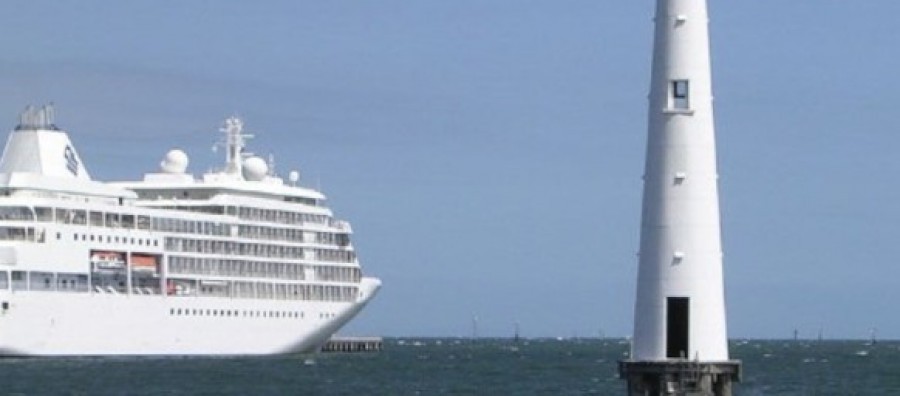
The BCNA is a not-for-profit community association in Port Melbourne. It is the successor organisation of the Swallow Street and Bain Street Residents’ Association formed in February 1987. It was formed out of fear that the Victorian Government would acquire their homes as part of an urban renewal project.
Purpose:
BCNA’s purpose is shown in its Rules of Association. It is to “… provide a forum for all residents of Beacon Cove and abutting neighbourhoods to discuss key local issues and thence to take appropriate action to preserve and enhance the quality of life for residents and visitors to the area…”.
How we operate:
BCNA representatives meet key people and organisations to find solutions to local issues. They include Members of Parliament, State Government departments, the City of Port Phillip, Victoria Police, developers, the Environment Protection Authority, and Ports Victoria.
Current issues:
Some of the recent issues BCNA has been involved in are:
• Hoon driving and excessive vehicle noise around Station Pier and Beacon Cove.
• advocating for air quality monitoring near Station Pier.
• advocating for the redevelopment of the Waterfront Place precinct.
• the enforcement of planning controls.
• protecting the foreshore from overshadowing from developments.
• An upgrade of the Princes Street stormwater drain.
• Port planning.
Communicating to members:
The committee reports on progress with current issues by short news items on the organisation’s Blog website at www.beaconcove.org.au. Members can receive these news items by subscribing to an email news service. In addition, a hard copy newsletter, The Beacon, is prepared twice a year and delivered to about 2800 mailboxes in the area.
Encouraging a sense of community:
In addition to the email news service, BCNA organises social events. Often these are dinners at local restaurants. The events are popular and attract around 60 plus attendees. They are a good way for newcomers to meet neighbours and to hear about local news.
Membership:
Membership is open to individuals. You do not need to live in the area. An application form is shown on the website at www.beaconcove.org.au. Current membership stands at 461.
Further information about BCNA can be found on the website www.beaconcove.org.au
Or contact:
The President at president@beaconcove.org.au
The Secretary at secretary@beaconcove.org.au

By Dean Hurlston, Ratepayers Victoria, Inc.
It is well established that Council CEOs move around the industry to advance their careers.
The vast majority of Large Council CEOs come from smaller Councils or roles within the local government sector. A review of CEO profiles on LinkedIn shows just how mobile Council Executive staff and CEOs are. They are always on the lookout for larger roles and larger pay packets.
Across Victoria there is an immeasurable talent pool from Private industry , but you will rarely, if ever, see any of the Private sector talent running our 79 Councils.
Local Councils do not have a definition in law that constrains them to rubbish, roads and rates which is what most people expect Councils to deliver on.
The Local Government Sector is awash with CEO’s and Executive staff that are in it for one reason and one reason only – to resume build, and they don’t want competition from the private sector.
When the Local Government Act was updated in 2020, the CEOs and their union (The MAV) took absolute exception to the Minister at the time (Adem Somyurek) inviting ratepayer organisations to make suggestions on what needed to be changed.
It was no accident, but it was a defining moment.
For me, it was the start of a study of the Local Government Sector and why CEO’s did not want the end user, consumers (residents and ratepayers) being anywhere near the legislative changes.
Many good suggestions made it into the original draft legislation, only to be removed by intense lobbying by the MAV and Council CEOs. Some of the changes sought to address the power imbalance the public has when dealing with the CEO and executive staff.
When power does not want to be accountable and is fastidious in lobbying against any resident and ratepayer protections, you know there is cartel behaviour behind it.
So what is this cartel?
Quite simply CEOs preside over budgets of hundreds of millions of dollars. They also have very high delegated spending limits (some as high as $2M). These delegations mean the CEO can spend this money without ANY accountability. Only if a spend goes over do they need Councillor permission.
There is a long established pattern in Councils (uncovered by the Victorian Auditor General VAGO, and the Ombudsman) of getting around delegated authority limits by breaking spends into smaller amounts to avoid scrutiny. This has been raised for many years by VAGO as a corruption risk, yet still nothing changes.
Further to this, CEOs use Council projects as the money makers to progress their own careers. These projects have slim, rhetoric-based business cases, if at all. They also use large swathes of ratepayers’ money or enormous amounts of borrowings. Either way, it is long known amongst the CEO group that the way to grow your career is to “BUILD STUFF”. CEOs often go to councils where there is a significant build pipeline because this is what motivates them.
It is of course these projects that build ones resume and career opportunities.
The boring stuff of council, running an efficient and lean business is absolutely not on the agenda.
Any listed public company director knows that a good CEO is able to do two things – run an efficient and cost-effective business and innovate to drive transformation that better serves its customers or stakeholders. Yet why is this the antithesis of Council CEOs?
Self Interest. If there is one thing all CEOs have learned in the political machinations of Councils, it is of their self-interest. They are not responsible to industry KPI’s, or standards and they can pretty much make anything up as they go. There are horrific stories across the industry of fraud, politicisation, and cost blows outs, but rarely if ever does a CEO get fired. If they find themselves in a position that is untenable, they are easily able to move Councils and leave behind the trail of destruction, for the ratepayers to pay for yet again.
The Council CEO industry is awash with Ego and hubris. They all regularly inform the government and ministers about their views of what needs to happen in the industry and so far we have a government hell bent on protecting the CEO culture instead of holding them accountable.
Let’s be clear here, many Council CEOs wouldn’t last a month in the private sector, accountable to a real board of directors. They don’t have the business acumen to run a lean and efficient organisation.
On the topic of building, we have seen so many communities oppose large projects and offer alternative cheaper models over the years. Every time they have been outmanoeuvred and outsmarted by CEOs and executive groups who have access to top lawyers, top experts and advisors who will do and say anything to defeat well-meaning residents and ratepayers.
This is the dilemma of Councils. A corporation, run by CEOs who do not have to answer Councillors questions, who keep councillors stage managed with only the information they want to share.
CEOs who have unfettered power. CEOs who can hide community grant recipients connected to Councillors. CEOs who can command internal reviews when things go wrong, but nothing changes. CEOs who buy luxury cars to keep mayors happy. CEOs who know that ultimately, they run this show and they call the shots. CEOs who know that building large projects keeps councillors happy too. These projects help their favourite councillors get elected and re-elected. CEOs who know that they can do things politically for Councillors that will keep them in a job. CEOs who can sit on boards and regularly be keynote speakers in businesses that profit from the sector.
CEOs who wouldn’t dare go to the public sector because that would be an impossible transition.
CEOs who know the sector doesn’t hire from outside, so they are always a protected species.
So next time you drive past a Council project worth tens of millions of ratepayer dollars, whether it be a pool, an indoor stadium, a multi-level carpark, a retail precinct, or a new Town Hall, just remember that this is the legacy of Council CEOs. Their only purpose. To build stuff for their resume and continue to grow the ever-ballooning number of staff at their beck and call.
While they are at it, they command salaries of $300,000 - 700,000 per annum. More than our highest paid state politicians, yet the CEOs are not elected and control $12 billion our money every year.
A Cartel, you bet!

by a St Kilda Elder
Friends in Brighton are astonished when I tell them what I pay for rates in City of Port Phillip - for a small house and frontage… oh and the couple of hundred dollars extra I have to pay, so I get to park on my street and to allow my 96 year old Dad a visitor parking permit if he visits.
So imagine my surprise, and my indignation when I recently discovered that CoPP is planning to kick in financially, to assist to our wealthier Bayside neighbours to upgrade parts of Elsternwick Park; including an Urban Forest and Wetland. It is only a few years ago that I tied myself to a tree on the old Beachcomber Marine Parade site, as I saw men with chainsaws arriving to cut down a bunch of very old (probably over 100 years) Washingtonia Palms (the very tall skinny ones) which had adorned the site. I thought CoPP was the greenie Council, with respect for “significant trees”. Yet these grand old graceful palms were hacked down, all over the block to make space for the 23 apartments which now stand there. Before the police came to escort me off the site, someone showed me a piece of paper which indicated the trees "were or would become unstable". Well yes, if you dug foundations or basements under them, of course they would become unstable! God forbid the architects could consider a slightly lower density urban French approach, seen all over central Paris, where apartments are built around enclosed gardens containing… trees!
Ok that’s one gripe off my mind! But now an “Urban Forest and wetland” in Elsternwick Park? I've walked a dog all around that park. I've played golf on the course. Seemed like there were plenty of trees and ponds to make my terrible golf game even crappier. Ducks and other birds abounded. Even frogs. It was a bit rough and ready in places - but then...that’s nature!!
On 21 March 2018 CoPP met to discuss “the development of an Urban Forest and Wetland in Elsternwick Park North, subject to confirmation that the Urban Forest would reduce flooding, improve public amenity and water quality, includes water harvesting and distribution and protects and enhances biodiversity.” [Meeting minutes Port Phillip Council 16/3/22: Exec Summary para 2.1]
Wetlands make sense, but so do composting toilets and I don’t see any of them around St Kilda/Elwood/Elsternwick. Perhaps the well-paid Council workers would prefer not to have to distribute humanure. Biodiversity, stormwater harvesting, and public amenity are all fab aspirations - on my teeny block I have water tanks and possum houses and amenity galore. However, the goal of the upgrade had as its first cited aspiration “...reduce flooding…” Having experienced firsthand the 1984 Kilda/Elwood flood, when canoes were paddling down Wordsworth Street outside my house and water was tiptoeing up to my veranda, I thought the flood mitigation plan, albeit in an adjacent Council, might be worth something to St Kilda/Elwood areas.
But the first part of the Masterplan to bite the dust was - yes you guessed - the “flood retention basin” as Melbourne Water “chose to instead pursue an alternative flood mitigation option.”
The cost to Bayside (without the flood mitigation basin) is to be around the $20 million dollar mark, of which $12 million is for the wetlands construction and stormwater harvesting components. Estimated costs for transporting water to Point Ormond, MO Moran Reserve are estimated to cost CoPP ratepayers $300k-600k and if transported further to St Kilda Botanic Gardens and the Peanut Farm - $3-5million. Wait for that Ratepayers!!!
Currently the CoPP ratepayers are already contributing funds as a "co-funder” of the design stage “...in the 2022/23 financial year …approximately $320,000 is required to project manage the design and engage consultants to complete the design.” [CoPP Minutes 16/3/22 para2.7]
And of course, it won’t stop there… So put your hands up Ratepayers of CoPP - who wants to kick in for yet another eco education centre, the urban forest which might not have been necessary but for CoPP block clearing for more high-density development meaning additional rates for them. Oh and increased amenity for a park that is not even in our Local Government Area.

By Jimmy Olsen
Sometimes we wonder if the council staff actually mean what they say. Here is an example from last week that seems, on the kindest interpretation, misguided. And possibly even …….. well what does our community think?
Last Friday (20th May) this flyer was hand delivered to all the shops in Clarendon Street with a welcoming smile to “join in the discussion”. We noted that the event scheduled had started 45 minutes prior to the invite being delivered and asked the obvious. How were we able to prepare for this? How were we able to attend given that we were all busy staffing our own shops and perhaps most bizarrely, why pay someone to hand deliver invitations to an event that was already almost half over.
We don’t use Facebook but have been bombarded (at least daily) on Instagram with the image of a City of Port Phillip staffer thrusting out a card “We want your opinion”. Fair enough, we feel confident that it is a good idea (if not a legal requirement) for our Councils to consult with the community, but we are left wondering if performing this role is possibly more about theatre, than substance.
It may be that when the council uses those other paid “consultants”, it is often receiving more “palatable” responses. Maybe even advice more in line with its own needs and ideas. Consulting with unpaid members of the community can sometimes lead to tougher processes. We understand their approach. We too are all for an easy life. And we certainly don’t feel ignored because, as she walked out (to deliver more late invitations) she turned to assure us that our thoughts would be “relayed to Council”. So that’s alright then.
Sometimes we wonder if the council staff actually mean what they say. Here is an example from last week that seems, on the kindest interpretation, misguided. And possibly even…….. well what does our community think?

Image by Sean Cummins - see full screen
A message from the School Council Presidents - Hannah Lawson & Elisa Webb
Dear Parents/Carers,
On Wednesday night, despite a petition with over 1,300 signatures and hundreds of emails objecting, the City of Port Phillip Council voted to go ahead with their plan to place a public toilet near the entrance of our school.
As a School Council we are very disappointed with this outcome and with the conduct of some Councillors in the meeting (particularly Cr Peter Martin, who said that SKiPPS parents need to educate their children more about safety).
We are not opposed to public toilets, but the location needs to be well considered and we believe that safety standards and cleaning regimes need to be above what currently exists elsewhere in the CoPP.
To summarise the vote:
- Cr Bond, Cr Pearl, Cr Copsey and Cr Martin voted to go ahead with the project
- Cr Crawford abstained from voting
- Cr Consulo, Cr Clark and Cr Sirakoff voted against placing the toilets in the proposed location and to stop the project.
You can Listen to the Councillors discuss the proposal at the meeting on 15 June from the 1 hour 48-minute mark in the webcast https://www.facebook.com/cityofportphillip/videos/836525410663145/
We encourage any school families or community members who wish to show their continued opposition to the construction of the toilets at the site to write to the COPP Mayor, Cr Pearl, and the CEO, Peter Smith.
Marcus.Pearl@portphillip.vic.gov.au
Peter.Smith@portphillip.vic.gov.au
It is also time to escalate the issue to elected officials at the State level, and we encourage you to contact the Education Minister, the Premier and our Local Member, Martin Foley.
james.merlino@parliament.vic.gov.au
daniel.andrews@parliament.vic.gov.au
martin.foley@parliament.vic.gov.au
The land in question is owned by Parks Victoria, so you can also write to the Parks Victoria CEO, Matthew Jackson, and the Chair, Hon. John Pandazopoulos.
John.pandazopoulos@parliament.vic.gov.au
If you have any other suggestions or contacts, please get in touch with School Council via Michelle at

By John Hawker
John Hawker, a resident in Gateway Ward has given PPM permission to publish his letter on rates to Port Phillip Councillors who will vote on rates rises on 29 June.
Dear Councillors,
I’ve never written to a local council in my 65 years of life; however, on this occasion, I feel compelled to do so after the recent Federal election. Voters are enlightened and there’s an “appetite“ for change. The two major party system is weakened, and this will flow into local government, unless our elected officials listen to their ratepayers. Teal is the new black!
I am a relatively long tern ratepayer; having lived in the area in two different premises in Gateway Ward since 2005 . I enjoy the amenity and proximity to beach and the city. In recent years I have become disillusioned with how the rates I pay you have been used. I’ve done some homework / research and find that my rates on a comparative basis are very high compared to other local councils. On further “digging“, I’m perplexed as to why CoPP has significantly higher operating costs compared to our neighbouring councils. There can be several reasons for this; however, I certainly do not see the level of service greater than other council areas. This has now prompted me to consider requesting a rate review. I also consider this given Councils desire to spend our rate money in another council area. Id support this if our council was operating efficiently; however, I feel it cannot be. On this basis, I also strongly believe councillors should consider a rate freeze. If you can spend money out of your rateable area, you have spare money. Freeze the rates and reward your ratepayers with some relief in these current extremely difficult times.
So, I seek your support for a rates freeze in 2022/23. You have a cash surplus forecast and our rates are already excessive compared to our neighbouring councils.
As a councillor , I believe you are accountable to ratepayers to represent our community. I can see from a number or projects that have happened whilst I remained quiet; are wasteful, inefficient, self- serving in some instances and don’t improve services. Surely your aim should be to enhance community benefit / improve service. I note the CoPP has the highest headcount and wages bill of all neighbouring councillors. I don’t see anything more to show for it. How do you hold the CEO and his executive team accountable? I also note that you don’t appear to “zero base“ your budgeting, which is international best practice. It seems your executive are simply adding a percentage year on year when they formulate the CoPP budget. This is not the way to glory. It’s the road to bankruptcy, inefficiency, and laziness. It’s a predictable process of built-in increases. Further, the year-on-year headcount appears to grow and there’s very little to show for it. I’d question the CEO on whether he’s building an empire and have him consider a headcount freeze; which the huge corporates I was involved in did business; particularly in difficult times for customers ( in your case read ratepayers).
Having our elected councillors consider a rate freeze, would indicate you are listening to ratepayers, and you do care about us. After significant trouble over the last 2 and a half years; and the impending issues we now face in the economy (inflation, interest rate increases, fuel, power, gas and food prices) we won’t see any relief imminently nor for the foreseeable future.
There is hardship in our community, but please don’t ignore me. At some point, those who can support the hardship cases, hit a tipping point. I’m there, hence why I’m now doing more research. The research, as mentioned, indicates I’m paying significantly more than ratepayers in similar sized premises for similar services. Thank you for waking me up to move my case forward re my rates.
Individual council areas have their peculiarities like beaches and markets etc. Please don’t insult your ratepayers by trotting out this excuse. It’s a benign argument.
I now learn that council is considering a waste charge. Please be honest and transparent in this with ratepayers. We are not stupid. This is a way to increase rates by stealth.
I ask you to support a rate freeze for 2022/23, as well as voting against a separate waste charge. Think about us , the people who voted for you . Think about how you spend our money. Think about the demographic of the people paying you the rates (pensioners, retirees, families, single people). Think about whether you are giving ratepayers value for their money. Think about the change in the air regarding elected officials.
Yours sincerely
John Hawker
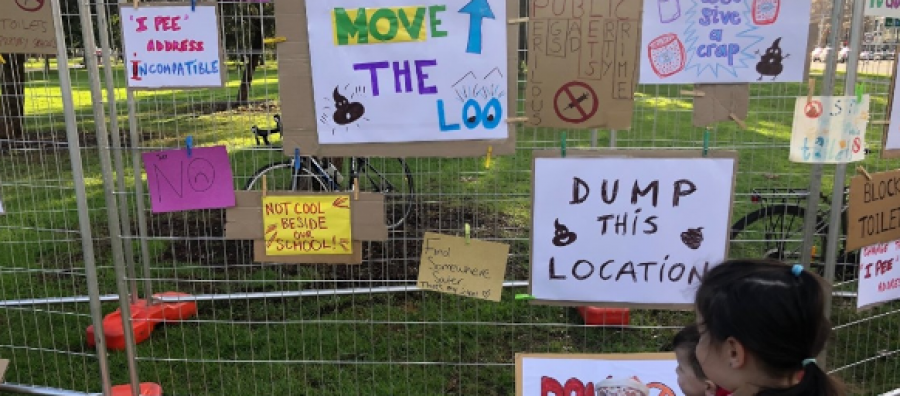
St Kilda Park Primary School (SKIPPS) community were disappointed that Port Phillip Councillors voted on 15 June to build public toilets metres away from the school. The decision ignores widespread opposition to the project, including the Albert Park MP and a petition containing more than 1,300 signatures.
Hannah Lawson, Vice President of SKIPPS School Council said, “As a School Council we are very disappointed with this outcome and with the conduct of some Councillors in the meeting (particularly Cr Peter Martin, who said that SKIPPS parents need to educate their children more about safety)”.
Hannah also observed that “Council run toilets in the Coles Car Park in Balaclava, Shakespeare Grove and on The Slopes regularly attract anti-social behaviours and are not cleaned and serviced regularly enough to provide a safe facility for the community”.
Five Councillors voted in favour of the proposal, three opposed the motion and one abstained (see details below). The majority decision approves the construction of the public toilet in the selected location near the school, while allowing discussions with Parks Victoria to “see if the toilet block can be moved slightly further north” (towards Princess Street). However, the motion does not guarantee that the toilet block will be moved further from the school.
The Councillors voting in favour of the public toilets near the school said there is a need for public toilets on Fitzroy Street. One councillor observed Council had attempted to build toilets in18 other locations over a 14 year period but have been frustrated by community opposition and petitions.
Claire Scothm, a St Kilda resident commented on the decision that “It shows how out of touch some of the Councillors are from the community. Failed to listen. Dismissed the petition and plethora of emails raising legitimate safety genuine concerns. Removed the kids protest notices straight away. No way of guaranteeing the toilets won't be filthy and used for everything but their purpose”.
SKIPPS opposed the proposal public toilets because of health and safety concerns. The petition states that Council has a poor track record of providing clean, safe, and well looked after public toilet facilities, and parents are very concerned that these toilets would present a safety risk to students, families, and wider community members. Importantly parents are concerned the proposed public toilet block will become an unsafe for children because these facilities attract drug users, discarded syringes and other anti-social behaviours.
SKIPPS advocated for public toilets to be re-located further down Fitzroy Street towards the beach to mitigate the risks of placing it next to a primary school and better meet the Council's stated aim to serve the needs of shoppers and bar and restaurant users, the majority of which are located between Grey Street and the Esplanade. Elisa Webb, a SKIPPS parent said “there is a long history of public toilets being built, and then closed or demolished due to public safety concerns in Fitzroy Street. Inviting these safety issues to the front of a primary school is unwise, with potential legal ramifications, especially as the feasibility studies have not included a formal risk assessment process”.
Listen to the Councillors discuss the proposal at the meeting on 15 June at the 1 hour 39 minute in the webcast https://webcast.portphillip.vic.gov.au/archive/video22-0615.php
Crs Clark, Cunsolo and Sirakoff voted against placing the toilets in the proposed location and to stop the project.
Crs Baxter, Bond, Copsey, Martin & Pearl voted to proceed with the construction of the new public toilet block.
Cr Crawford abstained from voting.
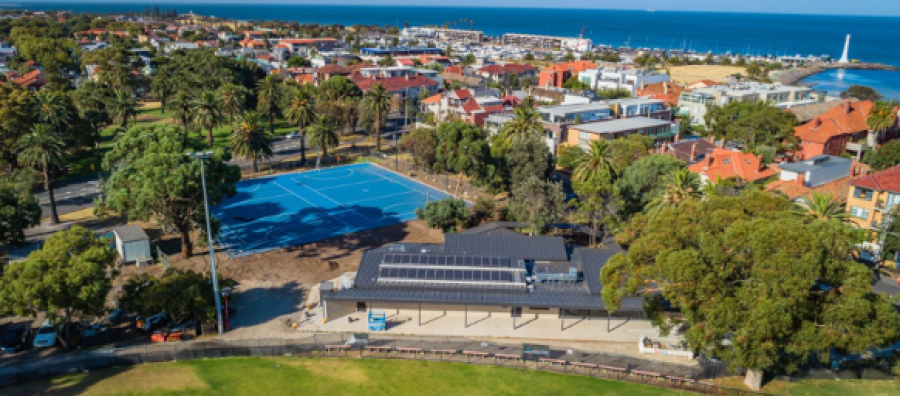
Image
of Peanut Farm sourced from CoPP website
by a St Kilda Elder
We all know water is a resource which, at least in the southern states, must be conserved at all cost. The proposed CoPP donation to the Elsternwick Park (Bayside) project, is partly justified by water CoPP is supposed to be able to transport from Bayside to CoPP, including to The Peanut Farm. Oh, did I mention? It will be a huge future expense, whether brought to our area by pipes or trucks. Or maybe ratepayers could have a low-cost community activity with a fun bucket brigade stretching from Elsternwick down Glenhuntly Road.
Recently I had occasion to wander around the Peanut Farm, the oval, and the nearby gardens. I was particularly interested in the footy pavilion. Lots of roof there. Lots. And so close to the oval which literally sucks water. Now being a mother, I do not begrudge the oval. I spent many a freezing night watching my kids play sport there. Although I was a little surprised when a few years ago, the whole oval was completely re-turfed, rather than replanted with seeds for the appropriate drought friendly grasses. So to my mind, and I confess I had a country girlhood, a large roof means large water tanks to collect large amounts of rainwater.
There is one small tank at the east end of the Pavilion, about the size I've managed to squeeze into my tiny yard. Maybe enough to flush the public toilets but certainly insufficient to service the oval. Water tanks now come in a range of shapes, sizes, colours. You can even buy tanks which are about 20 centimetres wide - which could replace all the old paling fences between houses. CoPP should consider water collecting tanks on every Council property. How many litres are harvested off the Town Hall? Every roof is sacred space for rainwater collection.
And to finish up this watery tale - I have photographs showing sprinklers generously spraying water around Renfrey Gardens when it was actually raining! I was appalled then. And I remain...

by a St Kilda Elder
It has come to my attention that the City of Port Phillip propose to introduce an extra fixed waste charge, despite little support with only 35% in favour (53% strongly disagree or disagree and 12% neither agree nor disagree), at a recent Deliberative Consultation. And despite some 12% of my rates being said to cover waste. Council will of course tell us that this waste levy will be revenue neutral in the first year; in that the extra bin charge will be offset by an equal reduction in existing rates, but the bin charge will be a source of an estimated $25 million of additional revenue in following years.
So, are they offering something extra? Can they make silk purses from the swine’s ears we lob into our bins?
We have never had green bins or food waste bins, as many other councils do, where rates are indeed lower that ours. Instead, those of us who are prepared to put our money where our mouths are, on the issue of sustainability and recycling, install our own worm farms and compost bins to handle much of the organic waste. It can even be done on balconies.
[FYI people: worms can tolerate soft paper, leaves and just about all food stuffs except anything from the citrus and onion/garlic families. Compost bins can handle citrus and onion. I warn folks about meat products as they can attract vermin and the last thing, I want is a Council Rat Catcher levy!]
CoPP seem always to be contriving to suck more money out of ratepayers. And they prefer the kind of income that is not constrained by the Fair Go rates cap which restricts rate rises to the CPI. So, this year the bin levy may not be noticed in our rates. But CoPP is optimistic enough to forecast increases of 6.4% in 23/24 and 10.4% in 24/25, subject only to the Essential Services Commission’s tick of approval.
So, is the waste levy just a ploy to sidestep the rates cap? I wonder which well paid consultant dreamed this one up.

By Ron B
Standing there 4am in an old t shirt and jeans the fire almost out, shivering thinking about getting something warm on. It dawns on me that what I am wearing are all the clothes I have. Everything else is gone, Burned or in the rubble of what was left of our home. I ended up finding some old farm coat that was in the garage ready for a trip to the Salvos, which made me look like some hobo and didn't flatter my 4pm appearance on the 7-news interview.
The next 3 days were a bit of a blur as we got the very basics of our lives resorted. I'd been living in the same clothes for 3 days till family and friends started outfitting us with new clothing and basic essentials such like toothbrush and deodorant, undies, hair dryer, brushes-n-stuff. Things just started to appear out of the blue from all sorts of people going out and shopping for us, family and friends collecting money locally and overseas and gifts of food and dinners each day. We didn’t cook for the first month after the fire. Not that we were short of cash, but these many acts of kindness helped us emotionally as well as physically. And the last thing I could do was go shopping as I was trying to cope with more than my tiny brain could handle.
Swarms of well-wishers, friends and family came to visit us over the first 3 days while we were staying next door with our neighbours, taking over their home, devouring refreshments and taking up couch space. A lot of hugs and tears were exchanged during those first days… Not that I am that way inclined, but I did choke up just a little when I initially rang the insurance company and it dawned on me the true state of our predicament. To that end my daughters fiancée took over the Insurance liaison roll, and things started moving forward gaining momentum.
The house itself looked like a bomb had hit, not that you could see anything from the front or for that matter from the back roadway but there was no roof at the back. Just a lot of blackened and jagged roof beams and a massive teetering Dorma window that was lurching towards the other neighbours house. This all needed to be made safe. If I was standing, there after the fire on my own I would not know what I would have needed to do first.
My knight in shiny red armour was our insurance company AAMI. They basically took over everything and lead us gently by the hand along a path that firstly made safe the house so that no-one would get hurt and the structure was a safe place for people to work in and not a danger to our neighbours.
They organised a team of demolition people and a 65-ton crane and basket that cut away all the dangerous protrusions and things that could accidentally fall any further. The crane helped to dislodge the massive Dorma into the house itself so there was no danger to anyone. They propped up what was left of the stairs so that there was access to the top floors. Then a team of people cleared access to areas of the house for the other teams of assessors, forensic inspectors engineers, electricians, plumbers, estimators, rubble removers and the contents removals people.
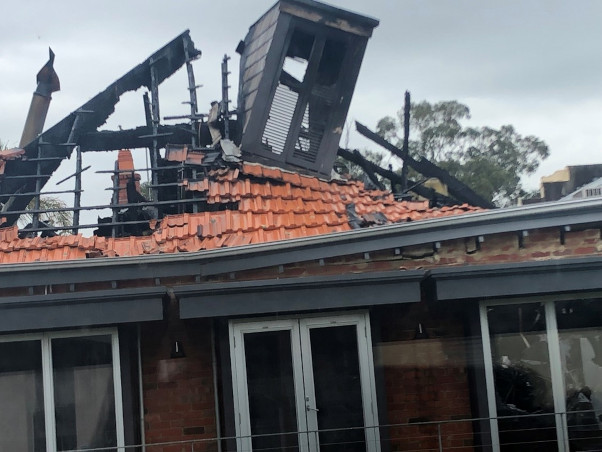
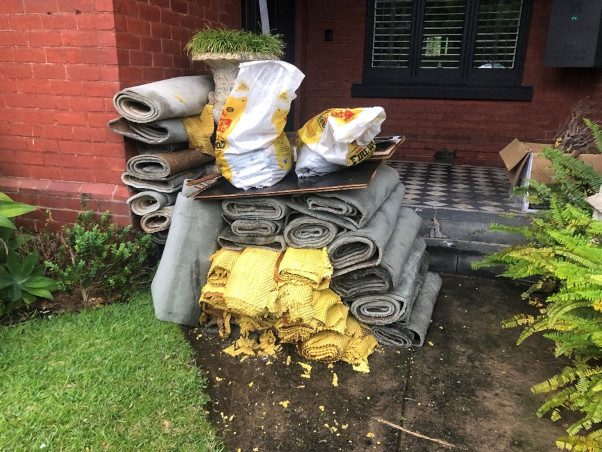
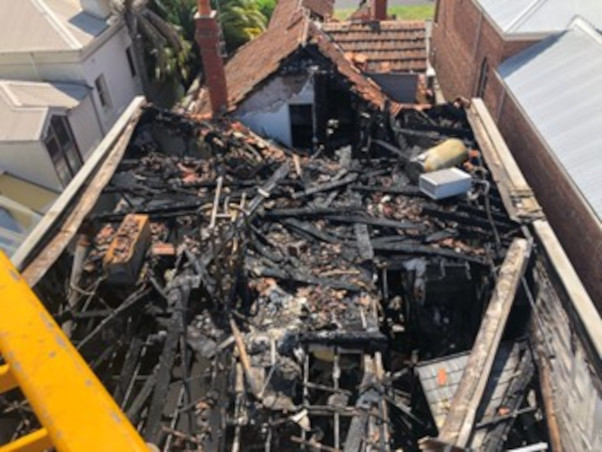
The way the system worked is that the building side of our policy is treated separately from the contents side. The building side we were given the choice of the Insurance company rebuilding the home to exactly how it was before the fire or the other option of being paid out the agreed or in our case the full insured amount. The contents side we were given a catalogued and photographic breakdown of all the items taken and disposed of including the items I had catalogued and photographed. Then it was up to us to nominate a replacement cost of each item which was then checked or adjusted by the insurer. A lot of work but a lot of money was involved.
From
my point of view our insurer was very fair and professional and we were treated
well. 30 years + being with the same insurance company... I am happy that
we stuck with AAMI (no this is not an ad). They were really good.
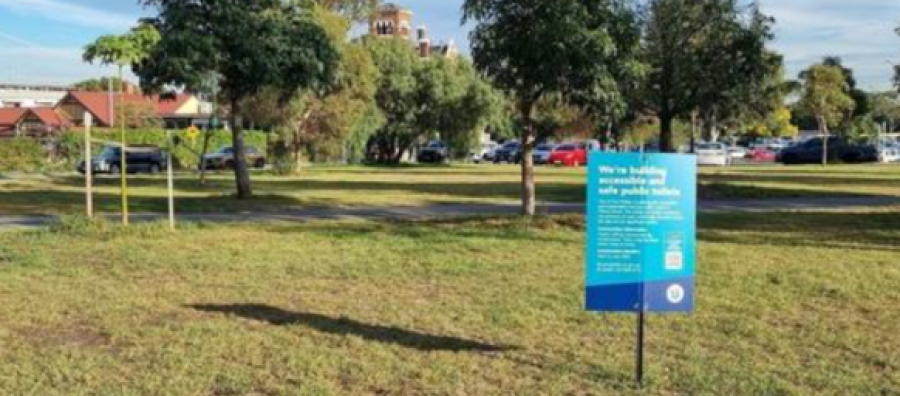
St Kilda Park Primary School are concerned about City of Port Phillip Council plans to build public toilets metres away from the school. Mr Neil Scott, Principal said “Whilst we understand the need for public toilets, other council-run toilets in St Kilda are allowed to be dirty, poorly maintained and a focus for anti-social behaviour. If this happens next to a primary school, our students, families, and whole community will be less safe”.
Mr Scott has asked resident to please consider signing our petition to find a better spot for public toilets on the street.
Petition · Reconsider the plan to build public toilets next to St Kilda Park Primary School · Change.org
The petition states the following:
The City of Port Phillip Council has released plans to construct a public toilet facility in the parkland facing Fitzroy Street, immediately in front of St Kilda Park Primary School. Based on the track record of the Council in not being able to provide clean, safe and well looked-after public toilet facilities, the School Council is very concerned that these toilets would present a safety risk to our students, families and wider community members.
Elsewhere in St Kilda, public toilets have become dirty, unsafe spaces that attract drug users and other anti-social behaviours. We believe that the risks of this happening within 15 metres of our driveway are unacceptable.
The Council has accepted that these risks exist but are determined to build new public toilets, believing that this location is the only option on Fitzroy Street.
We believe public toilets are important but that a facility located further down Fitzroy Street would remove the risks of placing it next to a primary school and also better meet the Council's stated aim to serve the needs of shoppers and bar and restaurant users, the majority of which are located between Grey Street and the Esplanade.
Through this petition, we seek to show the widespread opposition to this risky project in an inappropriate location and to urge Council to go back to the drawing board and find a better location for this facility.
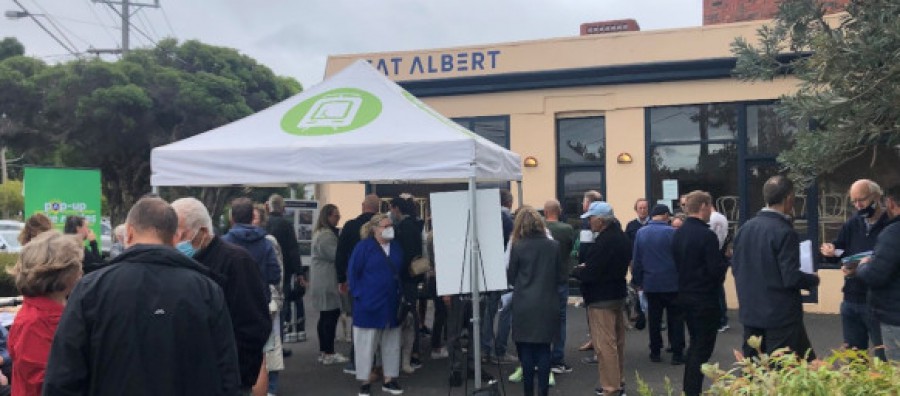
In a win for residents, Department of Transport (DoT) has announced the withdrawal of proposed designs for the pop-up bike lanes on Kerferd Road following extensive community consultation and based on the feedback received. This means DoT will no longer make any changes to Kerferd Road as part of the Pop-up Bike Lanes Program.
The decision is a win for residents who actively campaigned against the proposal. Heidi Ireland, a resident on Kerferd Road, together with her neighbours, obtained signatures from the majority of residents specifically impacted by the ‘parking separated bike lanes’ and organised residents to provide feedback to DoT officers at a marquee set up on the corner of Montague Street and Kerferd Road on Saturday 2 April. Residents objected to the ‘floated parking’ design, removal of car parking in front of their properties and loss of two lanes of car traffic which would have would have diverted traffic to local streets and worsened the rat run.
Heidi said “we are absolutely in support of making Kerferd Road safer for bike riders, however not at the cost of pedestrian safety, in addition to reduced access to homes. We believe there is a practical solution here - but unfortunately so far there has only been an all or nothing approach considered. We are still concerned plans for parking separated bike lanes and removal of two lanes of traffic will be revisited when Department of Environment, Land, Water and Planning (DELWP) construct their $13 million ‘Shrine to Sea’ project”.
DELWP’s website indicates the new boulevard connecting Domain Gardens to Port Phillip Bay along Albert and Kerferd Roads, will consider ‘improving safety and experience for people walking and bike riding’ and they have foreshadowed the ‘use landscaping to define a separate bike pathway on Kerferd Road to isolate bikes from cars’ https://www.environment.vic.gov.au/shrine-to-sea
It is concerning that the Department of Transport in relation to community consultation claim “Overall support for speed limit reduction, reconfiguration of Kerferd Road to one traffic lane and safety improvements” - source. Based on feedback from residents there is no support for reconfiguration of Kerferd Road to one traffic lane.
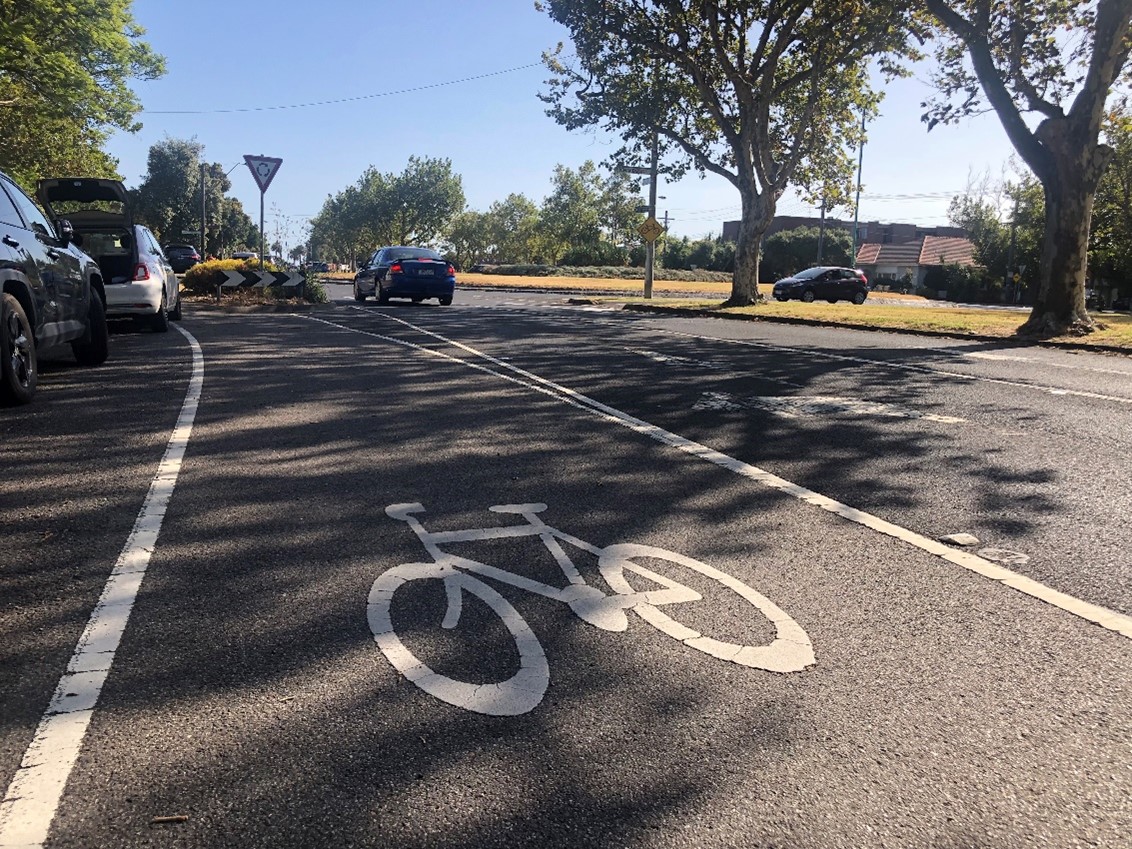
Greg, a resident who objected to the proposed pop-up bike lanes on Kerferd, objected to the plan to remove one-lane of car traffic in each direction at the Richardson Street Roundabout and on Albert Road under the light rail. Kerferd Road is a major arterial that connects Beaconsfield parade to Albert Road and Kingsway. Removing the lane under the light rail would make it impossible to get families to sport events at MSAC. Greg said that “This is a very wide road, with existing bike lanes, and would easily accommodate a better design solution that meets the need of bike riders and other road users. I would like Vic Roads to retain the two lanes of car traffic, introduce a 50 Km/h speed limit on Kerferd Road, and together with separated bike lanes that continue through the roundabout, this should be sufficient to meet the safety needs of all road users.”

Image from the ROPP election campaign in 2020.
According to a report paid for by Australian Services Union (ASU), the Victorian Government’s Fair Go rate cap has cost jobs in the local government sector. The ASU commissioned the Australia Institute’s Centre for Future Work to investigate the impact of the Victorian Government’s Fair Go rate cap which was introduced in 2016 to protect consumers from excessive increases in council rates. The cap limits increases in rates revenue to the Consumer Price Index (CPI).
The report titled “Putting a Cap on Community, The Economic and Social Consequences of Victoria’s Local Government Rate Caps Policy” concludes “The Victorian State Government’s policy to cap the rates of local government has cost the Victorian economy 7,425 direct and indirect jobs in 2021-22” The report also states, “The rate cap policy, imposed by the Victorian state government on local governments, interferes with the mission of service delivery and expanded, secure employment”. (Source: https://australiainstitute.org.au/report/putting-a-cap-on-community)
The ASU is the representative body for local government workers and is lobbying to abolish or amend the rate cap because it says their members “are increasingly overworked and underpaid in a way that is not in step with the broader public sector”.
With its tongue firmly planted in its cheek, the Ratepayer of Port Phillip (ROPP) ran an election campaign in 2020 asking, “How many council staff does it take to change a light bulb?” The campaign reported that Port Phillip rates are excessive compared to neighbouring Councils. This is because Port Phillip Council spends more than its neighbouring councils and the largest cost is employees. Benchmarked against other councils, COPP has much higher staff costs per resident. Does anyone kid themselves that Port Phillip needs 48% more staff per resident than Stonnington, 63% more than Glen Eira and 94% more than Bayside?
Therefore, it is not surprising that the study commissioned by the ASU is being used by the ASU for the benefit of their members. The study argues for the abolition of the rate cap to grow more jobs. This is offensive to those who pay rates and enjoy the protection of the rate cap. If the ASU had its way and thousands of jobs were added to Victorian Councils’ payroll, it would mean ratepayers would have to cough up hundreds of millions of dollars in additional rates annually.
Local government has been politicised by vested interested such as the ASU and political parties. ROPP was formed to elect Councillors to represent residents and businesses and not these vested interests. Since before the 2020 Council election, ROPP has set out to ensure ratepayers are armed with the facts about how their rates are spent.
Let’s bust some myths that are floating around COPP:
Myth 1: Services will be cut if Councils don’t get enough rates.
Reality: Councils needs to learn to live within their means like ordinary businesses and residents do. If times are tough, they need to evaluate choices and put some ‘pet projects’ to bed.
Myth 2: Councils need more staff as they deliver services like roads, libraries, planning etc
Reality: Many Council employees are employed delivering services to residents. But a large number are employed to write reports, commission research or promote the Council.
Myth 3: Council costs are increasing more than the rates cap, and they need a rise to keep up with cost increases
Reality: Governments, businesses and households are facing a reality of higher cost of living pressures after a long period of a benign inflation environment. Other levels of Government, not to mention businesses and taxpayers, have had to adjust to these higher cost of living pressures and so should the City of Port Phillip.
Myth 4: additional jobs can be created at no cost
Reality: They would require a huge additional tax burden in higher rates taken out of the pockets of local residents and businesses.
The ASU find the reality of budgeting and sound financial management to be an inconvenient truth. In response to our election campaign, the President of the ACTU, Michelle O’Neil, campaigned against ROPP endorsed candidates in a social media video during the 2020 Port Phillip Council elections. More recently the ASU is paying for research from the Australia Institute to confirms its desired outcome: more jobs for their members.
What do you think? Do you think residents can afford an uncapped rates system that would allow Councils to get away with amassing an even larger number of staff? Let us know your views at ppm.editor@gmail.com .

By Joe leong
On behalf of Representatives of the Park Street Neighbourhood Group (PSNG) (Residents and Property Owners of Park Street, South Melbourne)
Park Street, South Melbourne is getting a Department of Transport pop-up bike lane between Kings Way and Moray Street, but you would be forgiven if you knew nothing about it. This project is not listed on the Vic Roads pop-up bike lane program website so there has not been the normal process for community consultation about the project.
Rather, the pop-up bike lane has been embedded and well hidden within the Park Street ‘Streetscape Improvement project’ which according to Council of Port Phillip, aims to create a “safe, connected and refreshed streetscape” for those living on or nearby, travelling through and using Park Street. Protected bike lanes are proposed between Moray Street and St Kilda Road with:
- permanent construction between Kings Way and St Kilda Road
- temporary provision between Moray Street and Kings Way.
The ‘temporary’ reference is the only clue you will find in the Streetscape plan to this section being part of the Department of Transport pop-up bike lane program.
Residents and the broader community were asked to have their say about the Park Street Streetscape Improvement project just before Christmas last year. Despite being preoccupied with everything else that happens at that time of the year a number of Park Street residents raised concerns about elements of the proposal. In particular, these concerns questioned the:
- The need for a protected bike lane as there is already one just one block away in Albert Road
- The need for ‘floating parking’ along Park Street between Kings Way and Moray Street so the bike lanes can be positioned between parked cars and the footpath, and
- The need to remove 12 parking bays between Moray Street and Kings Way
I will broadly go through the background and response we received to each of these key concerns.
Duplication of the bike path in Albert Road
Why is a second bike lane needed just one block away from a protected lane on Albert Rd, which connects the Domain to Moray St? This existing bike lane connects cyclist to local attractions like Albert Park Lake and the Aquatic Centre. Council planners point to the findings of the Comparative Assessment of Park Street Bike Link Technical Note (sponsored by council) and prepared by CDM Research, which found that the Albert Road bike path was a poor alternative to the Park Street as it may add an extra 400m to a cyclist’s trip. For comparison, Council considers it reasonable for residents who will lose parking spaces due to the bike lane, to walk up to 400m from their property to where their car is parked. So, residents can be expected to walk 400m, but cyclists shouldn’t cycle that far!
It was also argued by Council planners that the Park Street bike lane would serve demand for, and provide a more direct link between, South Yarra and Port Melbourne, Docklands and ultimately Fisherman’s bend. On such a long route, an additional 400m seems insignificant and the question remains: why can’t the bike route go along the existing Albert Rd bike lane?
Finally, it was argued by Council planners that the Park Street bike lane was required to protect existing cyclists using Park Street as this area had been nominated as a road safety blackspot, with 20 crashes recorded in the past five years. This figure is at odds with the data presented in the Comparative Assessment of Park Street Bike Link Technical Note, which notes that 18 crashes involving cyclists were reported along Park Street between 2010-2020 with 12 occurring between Moray Street and St Kilda Road. Most importantly, it is emphasised in this technical note that most of these accidents occurred at or near intersections and therefore the success of the bike lane in improving safety was much more dependent on intersection treatments than having a dedicated bike lane along Park Street.
Floating Parking – where carparking is to be placed between the bike and traffic lanes
The bike lane design places it on the inside (i.e. kerbside) of parked vehicles so carparking spaces lie between the bike lane and the moving traffic lane. The critical concern about this placement, particularly amongst older residents and those with young children, is the requirement to have to cross the bike lane each time to access their vehicles. We have all seen how bike riders often travel at high speed along these dedicated bike lanes. This is an accident waiting to happen. Another concern was that this is inconsistent with the carparking along adjoining areas including Moray Street, which is positioned between the parking spots and traffic.
Council’s solution to these concerns is to place a buffered zone up to 1.5m between the bike lane and parked cars in areas where there is adequate road width. We fail to understand how this mitigates the need to have to cross the bike lane every time you need to access your vehicle!
Loss of 12 parking bays to construct the bike lane
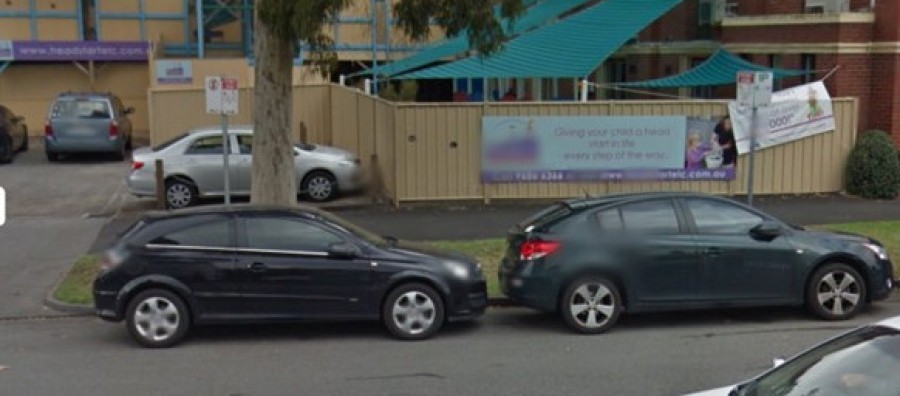
The proposed bike lane will have high impact on the ambience and amenity of this section of Park Street and will involve a loss of 12 car parking spaces. As there are only 31 car park spaces in the area available to residents, this represents a significant 20% of loss of car park spaces. Council have offered to make available 4 Taxi Zone bays as a replacement for this loss. Raising concerns about the loss of this scarce resource has also not been without some baffling responses from Council planners. They argue that two of the proposed spaces to be removed are redundant childcare Permit Zone parking spaces and therefore should not be included in the tally of lost car parking spaces. But as the photo above (sourced from Google Maps archive) shows, only ever one bay was assigned for this permit zone.
Examples like this leave the impression that the consultative process has been inadequate. It has not provided the community the opportunity to raise concerns compared with other Department of Transport bike path proposals.
We are petitioning the Minister for Public Transport, Minister for Roads and Road Safety to rectify this by allowing the Park St proposal to be lodged on the Vic Roads pop-up bike lane program website and to then follow the same procedure as other pop-up bike lane proposals.
If you would like to sign the petition, please contact Joe Leong by email leong1309@gmail.com or call him on 0413 025 404.
Written by Joe leong on behalf of Representatives of the Park Street Neighbourhood Group (PSNG) (Residents and Property Owners of Park Street, South Melbourne).


By Ron the Green Genie
View the World’s First Fish-Less Fish video story: https://www.youtube.com/watch?v=8RpjGj1z38U
What can we do in the City of Port Phillip to reduce CO2 emissions and address climate change without expensive wind or solar farms and endless rhetoric from our political parties? We can do a lot and it starts with something as simple as what we are putting into our mouths.
I came across this interesting video where smart people are challenging the way we look at food and how by changing our eating habits we can make a positive impact. Having been a vegetarian for many decades I have seen the changes to the varieties of plant-based foods that are now gracing our supermarket shelves. Lentils, mung, and soybeans are no longer the only hippy vego food available and if you are eating out and the restaurant offers you a vegetable stack alternative ask for the chef to come out and stack it where the sun don't shine. There are great, tasty fabulous alternatives available everywhere now and the plant based revolution is in full swing.
Welcome to the new age of plant-based foods where alternatives to meat, dairy and fish are freely available at your supermarket. And the best thing is that we are at the tipping point of where this plant-based food revolution is heading. I’m predicting that in the not-too-distant future we will all be consuming different styles of plant-based foods in favour of the real thing.
'And why the bloody hell should we move away from meat?'... you ask
Well beef and sheep production attributes to over 10% of the Australia's greenhouse gas emissions as well as production and processing emissions and soil degradation. Then there’s dairy, pig, and poultry emissions and so it goes on.
I know a lot of people will defend to the death their right to eat meat and I am not here to judge. I was a big meat eater growing up in a European household with a father that was a high-end chef specialising in meats and sauces. So I ate a lot, I mean an awful lot of meat. But that puts me in a prime beef position to tell you that some of this new plant-based food is so close to the real thing that even staunch meat lovers would find it hard to differentiate.
But don’t take my word for it. Try it. I would recommend that if you want to give it a go, and this is not an advisement, or if it is it’s not a paid ad. Try a "BEYOND MEAT” Burger, available in all good supermarkets, and I think some fast-food chains may even offer these. Then with an open mind let me know what you think.
My reason for converting to plant-based foods was initially more for health reasons but the environmental and animal welfare issues have over the years crystallised my move away from animal-based foods.
These new foods offer people a bridge to move to a healthier and more environmentally responsible food source. And a simple way you can save the planet in your local community.
The Green Genie

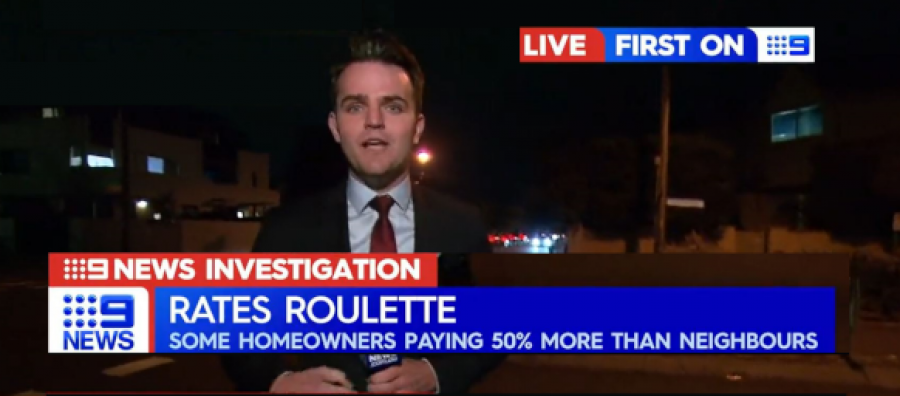
9 News reported on Port Phillip ratepayers on 26 April following the publication of our rates calculator and animation. see Twitter video here
We are paying more rates and charges in Port Phillip you than our neighbouring local government areas Port Phillip’s operational costs are approximately 30% higher than Stonnington and Glen Eira, and 100% higher than Bayside. Use the ROPP calculator to check your rates and charges, click here.
High rates in Port Phillip cannot be explained by number of residents, number of properties, size of the municipality, length of roads, or the type and number of assets. See Fact check update: how high are Port Phillip rates compared to neighbouring councils? - Ratepayers of Port Phillip (ropp.org.au)
The City of Port Phillip says Port Phillip is exceptional because we have high profile events, South Melbourne Market and beaches, but Stonnington has the Prahran Market, a golf course and two swimming pools. Bayside has beaches. Benchmarking indicates Port Phillip provides similar services to other LGAs but spends much more on most service areas except waste management.
Will Councillors freeze rates and acknowledge that our community is also impacted by cost-of-living pressures? Or are they out of touch with the broader community who want affordable and sustainable rates and value for money? Rates represent a large proportion of household expenses and impact our cost of living. Our community has been impacted by the pandemic and now cost of living increases. Councillors have an opportunity to re-establish trust and goodwill with the broader community when they consider increasing rates again on 1 July 2022.

Did you know that we are paying more rates and charges in Port Phillip you than our neighbouring local government areas?
Ratepayers just have to talk to their friends in other LGAs to know Port Phillip rates are excessive and that they are getting poor value for money.
For example, rates and charges for the median priced house of $1.8 million in Port Phillip are $3,436 which is $1,249 more than Stonnington, $895 more than Bayside, and $644 more than Glen Eira.

Source: https://ropp.org.au/property-rates-calculator/
Port Phillip's operational costs are approximately 30% higher than Stonnington and Glen Eira, and 100% higher then Bayside.

Source: Port Phillip, Bayside, Glen Eira and Stonnington 2021-22 budgets
High rates in Port Phillip cannot be explained by number of residents, number of properties, size of the municipality, length of roads, or the type and number of assets. See Fact check update: how high are Port Phillip rates compared to neighbouring councils? - Ratepayers of Port Phillip (ropp.org.au)
The City of Port Phillip says Port Phillip is exceptional
because we have the South Melbourne Market and beaches, but Stonnington has the
Prahran Market, a golf course and two swimming pools. Bayside has beaches.
Benchmarking indicates Port Phillip provides similar services to other LGAs but
spends much more on most service areas except waste management.
Use the ROPP calculator to check your rates and charges: https://ropp.org.au/property-rates-calculator/
Our community has been impacted by the pandemic and now cost of living increases. Rates represent a large proportion of household expenses and impact our cost of living. Councillors have an opportunity to re-establish trust and goodwill with the broader community when they consider increasing rates again on 1 July 2022. Will Councillors freeze rates and acknowledge that our community is also impacted by cost-of-living pressures? Or are they out of touch with the broader community who want affordable and sustainable rates and value for money?

Port Phillip Council proposes to introduce a new waste management plan which does not go far enough to divert waste from landfill. The plan will be funded by a separate waste charge, estimated to cost residents and ratepayers an additional $25 million over the next 10 years.
Council proposals
Single Unit Developments (SUDs) which include approximately 15,000 houses and terraces plus nearly 3,000 townhouses (only those with at least 30% of the property not covered by buildings):
- weekly kerbside collection of food organic and green organic (FOGO) bins;
- reduce landfill waste collection frequency to fortnightly;
- pay an additional 50% surcharge on the waste levy.
Multistorey unit developments (MUDs) i.e. more than 50,000 apartments
- keep existing weekly landfill waste bins;
- access to community FOGO bins.
People living in multistorey apartments will have to walk up to 300m to put their green organic and food organic waste into community bins. Council have assumed that apartment buildings do not have sufficient space for kerbside FOGO bins. But apartment blocks already have landfill/recycling bins, and most have car parks that should be able to accommodate FOGO bins. Council’s Waste Management Review Engagement Summary Report revealed significant community concerns with the viability of community hubs, which seem to have been brushed aside. Indeed, both Bayside and Glen Eira Councils provide kerbside FOGO bins to apartments. Is Port Phillip Council effectively saying that apartments in Port Phillip are different? Even the City of Melbourne is rolling out FOGO bins to multi-unit dwellings between two and five storeys high.
Unlike neighbouring Councils, is Port Phillip Council just giving up on attempting to divert food waste (from apartments) from landfill?
Environmental Impact
Composting food scraps and green waste instead of sending them to landfill significantly reduces carbon dioxide emissions. When food scraps and other organic materials are sent to landfill, they begin to rot anaerobically (without oxygen) and release greenhouse gases, primarily methane, which contributes to climate change. The impact of methane on climate change is around 25 times greater than carbon dioxide. In fact, about 3% of Australia's total greenhouse gas emissions comes from organic matter rotting anaerobically (without air) in landfills. Source: https://compostrevolution.com.au/
Port Phillip is one of Victoria’s worst performing Councils in waste diversion because it sends 68% of its waste to landfill compared with similar LGAs (51%). The introduction of FOGO bins would divert kerbside waste from landfill. (Source: https://knowyourcouncil.vic.gov.au/councils/port-phillip/reports/summary)
A Middle Park resident said “The proposal is disappointing from an environmental perspective because Port Phillip Council has effectively said that they are not interested in increasing waste diversion from landfill for 75% of properties (MUD's). If Council thought that communal FOGO drop off points worked, they would reduce the landfill bin pickup frequency to fortnightly for MUD's- just as they are for the SUD’s”.
Port Phillip’s new waste proposal contradicts their 2019 declaration of a climate emergency and exposes it as just virtue signalling. If Port Phillip Council was serious about climate change, they would implement kerbside FOGO to MUDs and collect landfill bins every 2 weeks, just like Bayside and Glen Eira. Instead, we have an overly complicated system, which will be difficult to administer and hence presumably require more employees. They have not even publicised a list of which properties are designated to receive kerbside FOGO bins and hence pay the 50% waste levy surcharge.
One resident who attended Council’s Deliberative Consultation in February said he “was shocked that Council had ignored community feedback that the most people living in MUDs would not be motivated to take their food waste and other organic waste to communal bins up to 300m”.
Economic Impact
All properties will pay $176.20 in 2022-23 for the standard landfill/recycling bin services, which comes with access to community FOGO bins.
SUDs will be charged an extra 50% ($88.10) for kerbside FOGO bins and will revert to fortnightly landfill bin pickups.
The new waste charge is revenue neutral in the first year, meaning Council will not be raising additional revenues in 2022-23 i.e. the total amount of rates collected will reduce by the total amount of waste levy collected. But it is forecasting an additional $25 million in waste charges over the next 10 years. It can do this because the waste charge will not be constrained by the Victorian Government rate cap that was brought in to protect residents and ratepayers.
One concerned resident said “Glen Eira and Bayside have determined that all properties can have FOGO bins yet Port Phillip hasn’t. Is this to save money? Council have been telling us that MUDs are not able to use FOGO bins for years. I contacted them about 5 years ago asking why we don't have FOGO bins- their answer was that over half the residents (those in apartments) can't use them. As if half the residents don't have food waste?”
You can have your say on this proposal which is part of the Draft 2022-23 Budget, Neighbourhood conversations 2022 | Have Your Say Port Phillip and you can attend the following Pop-up sessions to provide feedback:
- Sunday 1 May 2022 10:00am – 1:00 pm, 50 Albert Road, South Melbourne
- Friday 6 May 2022 10:00 am – 12:00 pm, Ripponlea, Glen Eira Road, cnr Quat Quatta Avenue
- Saturday 7 May 2022 09:00 am – 12:00 pm St Kilda / St Kilda West Veg Out St Kilda Farmers Market
- Friday 13 May 2022 10:00 am – 01:00 pm, Balaclava - St Kilda East, Carlisle Street, Balaclava Station
- Saturday 14 May 2022 11:00 pm – 12:00 pm, Albert Park / Middle Park, Canterbury Place Reserve, Armstrong Street
- Sunday 15 May 2022 10:00 am – 01:00 pm, Port Melbourne, Bay Street, outside Coles entrance
- Friday 20 May 2022 10:00 am – 01:00 pm, South Melbourne, Market Street, outside South Melbourne Central entrance
- Sunday 22 May 2022 10:00 am – 01:00 pm , Elwood, Ormond Road cnr Docker Street
By Matthew Fagan
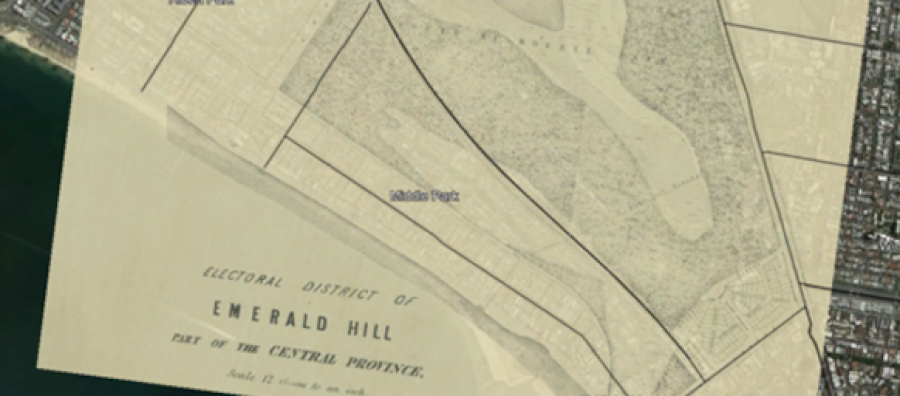
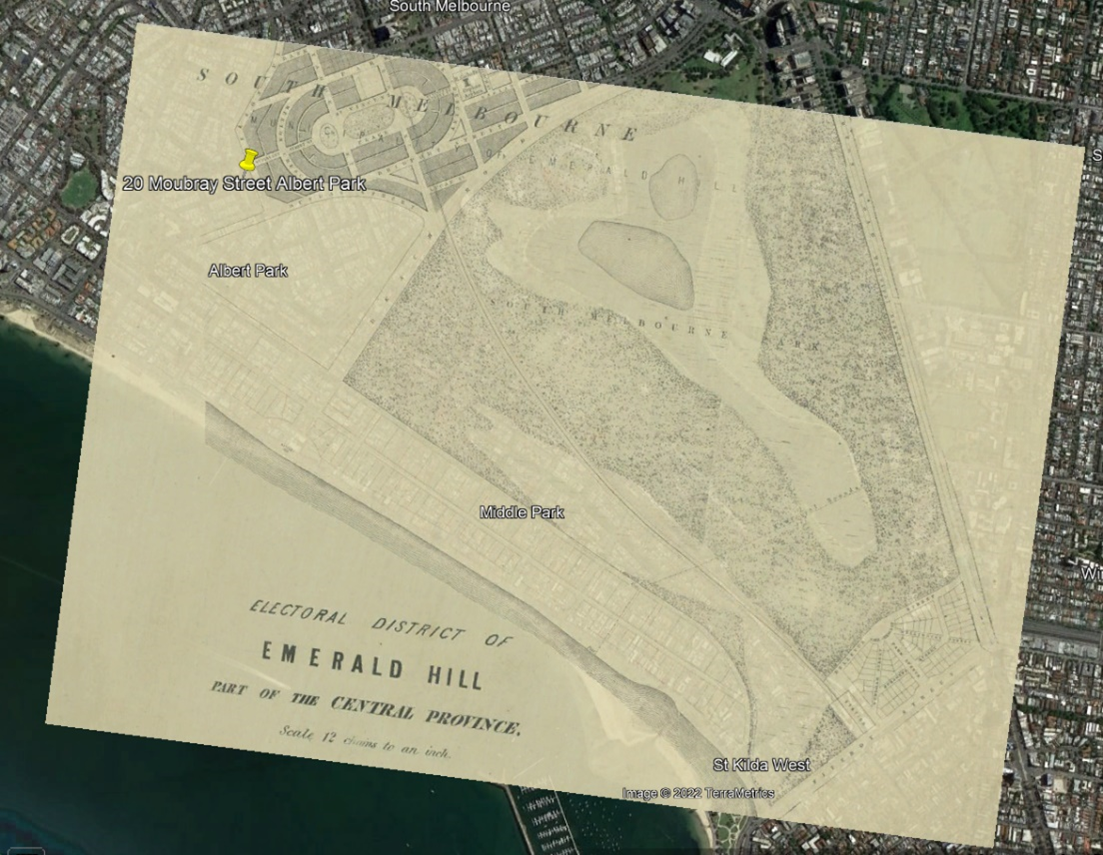
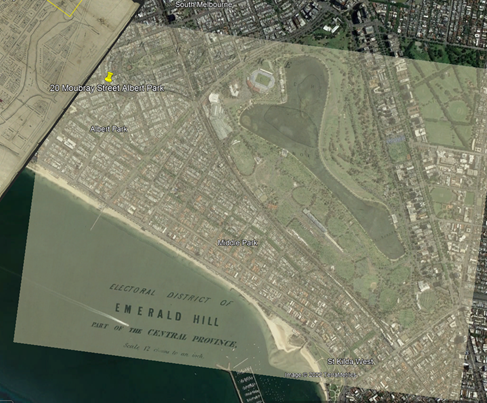
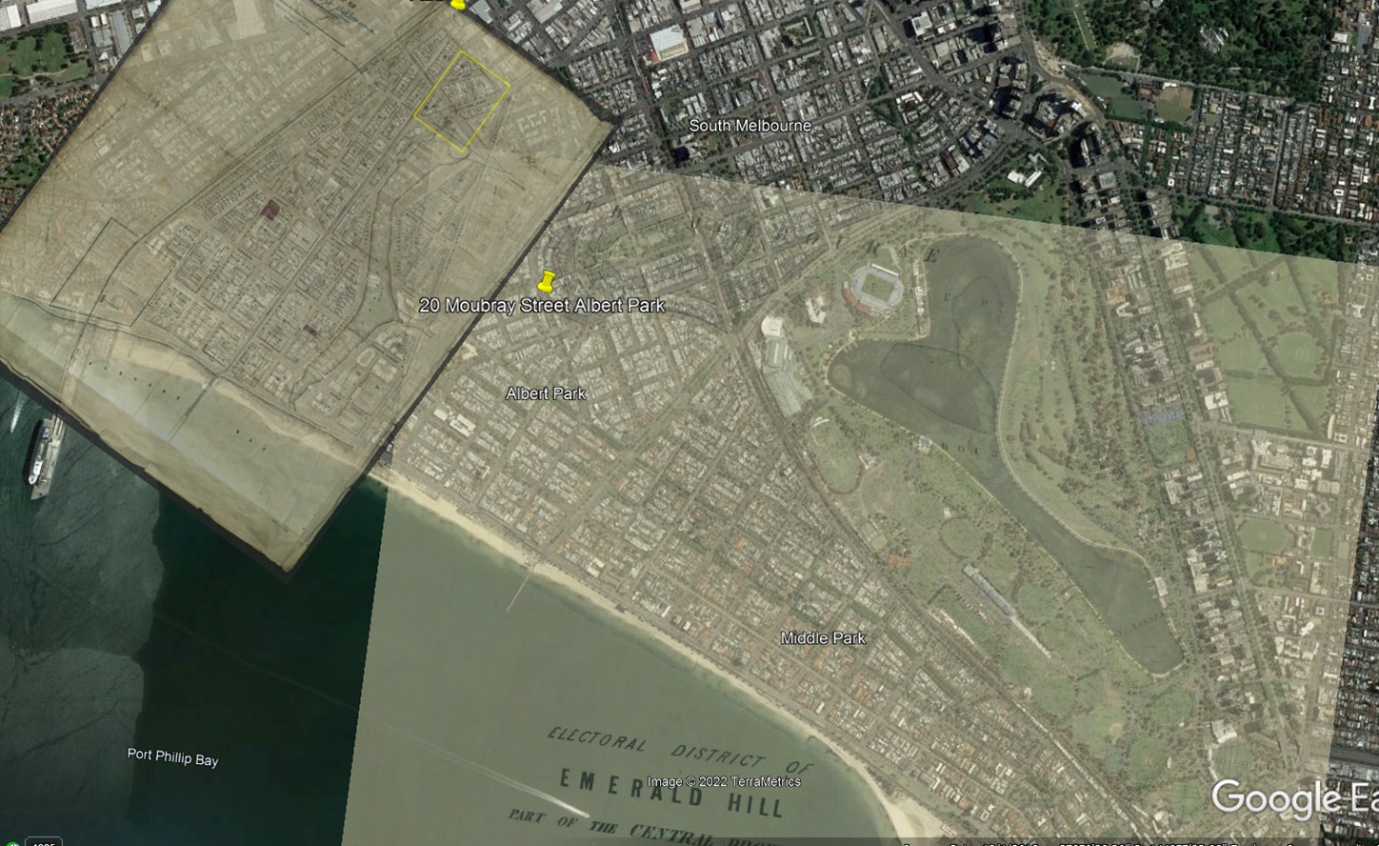
Middle Park residents may be interested to see how our suburb has changed since 1857. I have overlaid maps from 1857 on Google Earth, with a little adjustment for size, orientation and varying the transparency of the old maps. This is a middle level transparency overlay from 1857.
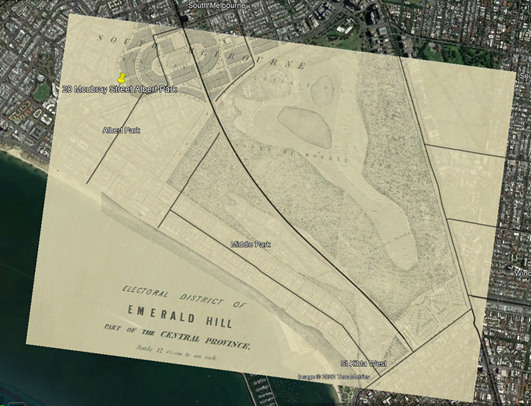
Middle Park residents may be interested to see the extent of the lower lake which bordered the park and no longer exists. You can see the lower lake bordering Canterbury Road and Park Street on this plan. The map shows planned development indicating that a good number of the houses were built on what was a lake. You can see also the historical boundary between the City of St. Kilda and the City of South Melbourne which explains the dog leg in Fraser Street. If you look at the 1857 map the diagonal line was in fact at right angles to St. Kilda Road and joined to the old Fraser Street which was at right angles to the shoreline. This created the kink in Fraser Street with the bent section across the now non-existent lake.
And Fraser Street is still the boundary of St. Kilda West and Middle Park.
And on the North from about Armstrong to Mary Street, the lake continued, explaining much of the deep depression on the North Side of the St. Kilda railway line which was completed only 4 years after the map in 1857 but which is shown, albeit slightly differently, on the map. I have highlighted on the ‘transport’ routes to allow the easy alignment and scaling of the map.
In the next map you can see more clearly without these modern lines and with no transparency, the map fits perfectly.
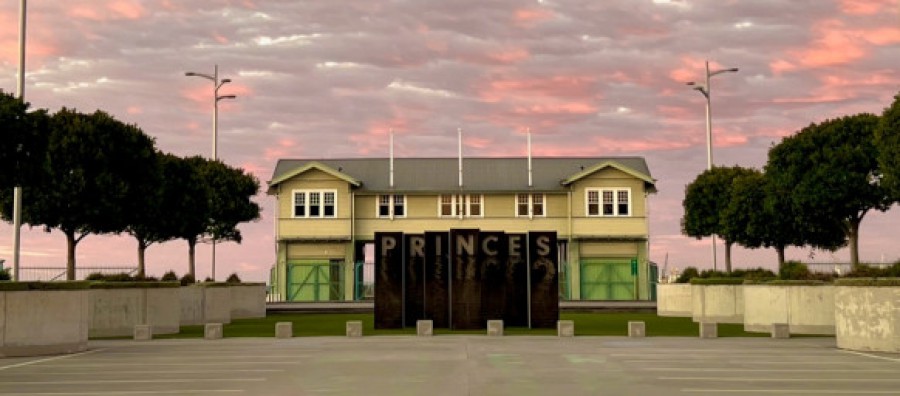
In this issue we showcase photographs taken by Teresa, a resident of Port Melbourne. You can see that each image is taken at the time of day when the ambient light serves to illuminate the subject beautifully. Also, the subject of each image is nicely framed within the image. Teresa clearly demonstrates her photographic skills with these shots.
If you would like to participate in our competition please click here to send us your images. We shall publish as many images as possible. However, if we are pleasantly flooded with entries, our editorial team will select those to be published and choose the wining image. If we publish your image, beneath it we shall display your first name and the first letter of you family name as seen below.
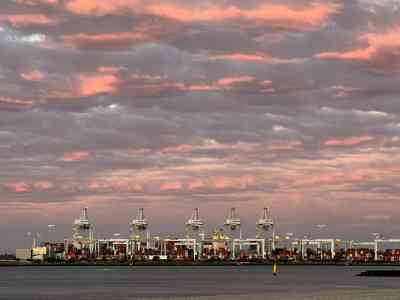
Image 1 by Teresa K
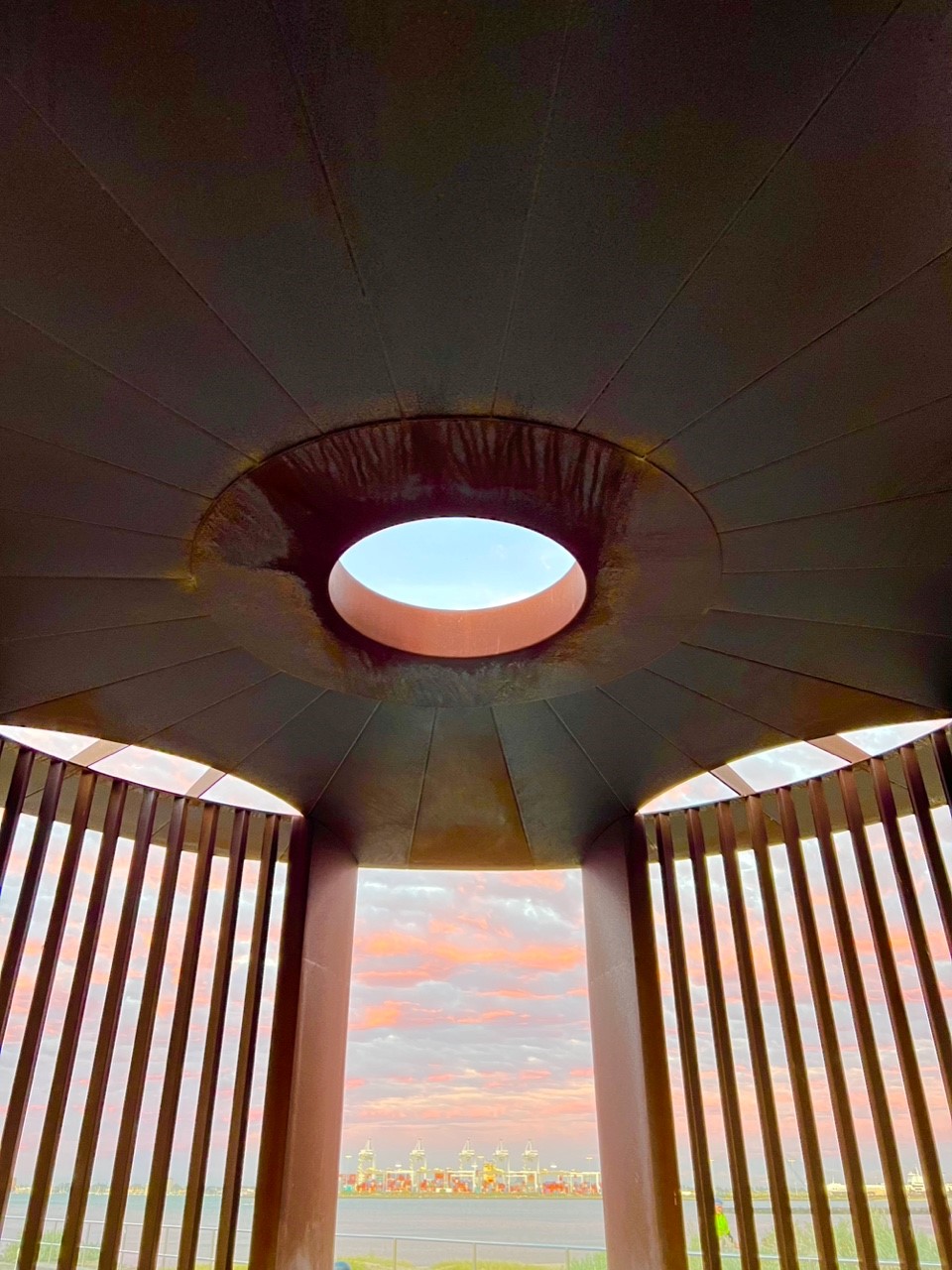
Image 2 by Teresa K

Image 3 by Teresa K
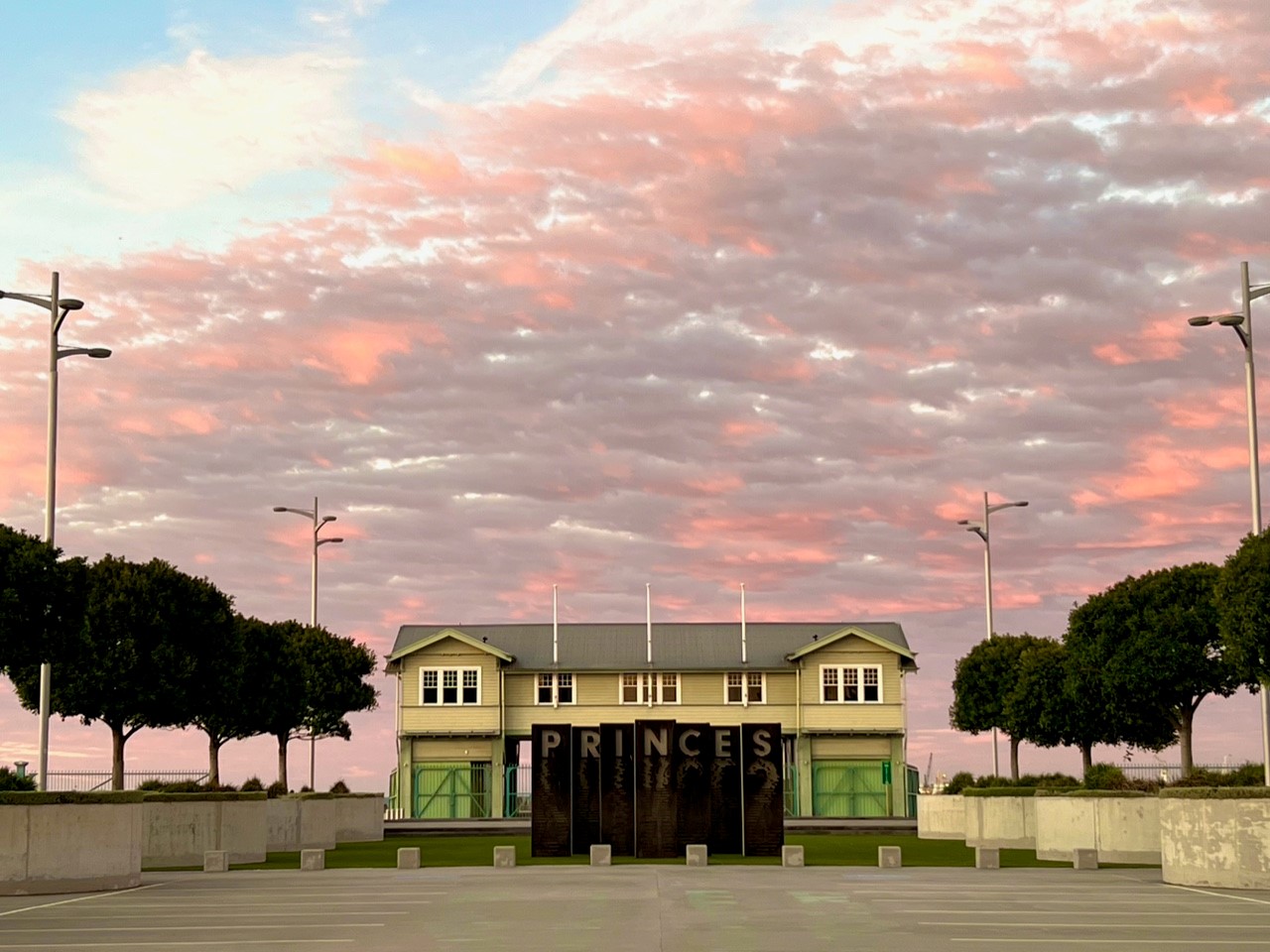
Image 4 by Teresa K

Everything but the kitchen sink ended up on a Port Melbourne street in a shocking illegal dumping act last month.
Council are appealing for information to assist our investigation into the illegal dumping of an entire demolished house.
After receiving a tip-off Council Officers found the dismantled house and other building materials dumped at the end of Graham Street, with Port Phillip ratepayers ultimately paying the price to clear the area.
Dumping rubbish is illegal and punishable under our Local Laws.
Additional signage is now in place warning about the consequences of dumping rubbish, which carries a fine from $660 up to $9,900.
Council Waste Management team actions more than 5,900 reports of dumped rubbish every year, from discarded furniture to mattresses and fridges, and collects about 50 tonnes of illegally dumped waste every month. About 70 per cent of all material collected is recycled.
Residents can use the Snap, Send, Solve app to alert Council Officers to public space issues including dumped rubbish.
If you have any information that may help us identify illegal dumpers, council would like to hear from you on 03 9209 6777.
Illegal dumping can also be reported to the Environmental Protection Authority's (EPA) 24 hour pollution hotline on 1300 372 842.


By Cr Christina Sirakoff
The first official Lemnos Gallipoli Anzac Day Service was held today (21st April 2022) at the Lemnos Square, Albert Park. The commemoration of the critical role that Lemnos played in Australia’s participation in the Gallipoli campaign during WWI began with four members of the Presidential Greek Guards marching into Lemnos Square and to then flank the Lemnos Gallipoli Memorial for the duration of the service.
The event was attended by many including State and Federal dignitaries (Ms Nina Taylor MP, The Hon David Davis MP, Mr Steve Dimopoulos MP), President and Members of the Lemnos Gallipoli Commemorative Committee (Mr Lee Tarlamis OAM MP and MC Christina Despoteris, Mr Jim Claven), The Consul-General of Greece in Melbourne, Mr Emmanuel S Kakavelakis, Mr Peter Corlett OAM (memorial sculpture) and representatives from the military sectors and councillors from other LGAs. I was proud to lay a wreath on behalf of the City of Port Phillip on this moving and significant occasion.

The Australian Defence Force’s campaign in Gallipoli in the First World War has long been recognised as a significant part of Australian history. What has not been sufficiently recognised is the critical role the nearby Island of Lemnos played in the Gallipoli campaign, and the specific Australian aspects of this involvement. Lemnos’ role in Australia’s ANZAC legend should not be forgotten:
- Lemnos island Greece was the principal assembly, embarkation, and supply point for the Gallipoli landings.
- The landings at Gallipoli were practiced on Lemnos prior to their deployment at Gallipoli and the islands’ harbour was a major staging post for naval operations in the Gallipoli campaign, including Australia’s AE2 submarine campaign.
- Most Anzac troops spent time on Lemnos – whether preparing for the landing, resting or recuperating at its rest camps or recovering from the horrors of war in its field hospitals.
- Lemnos was the location of the major nursing stations for the Gallipoli campaign, with 130 Australian nurses, led by Matron Grace Wilson - the first major overseas deployment of Australian Nurses to a war theatre.
- The recently formed Australian Red Cross Society was represented on the Island, through its aid depot and in the distribution of aid parcels to nurses and soldiers.
- Several major Australian military figures visited and were photographed on the island, such as Albert Jacka VC and Generals Birdwood and Monash.
- The armistice concerning the allies and the Ottoman Empire was signed on board HMS Agamemnon in Mudros Harbour, Lemnos in 1918.
- Lemnos is the location of two major but under-recognised Commonwealth War Graves, with 148 Australian graves.
The statue by Mr Peter Corlett (pictured above) features an Australian nurse on Lemnos, with a wounded Anzac soldier is reflective of the Lemnian earth and motifs, evoking classical Greece.
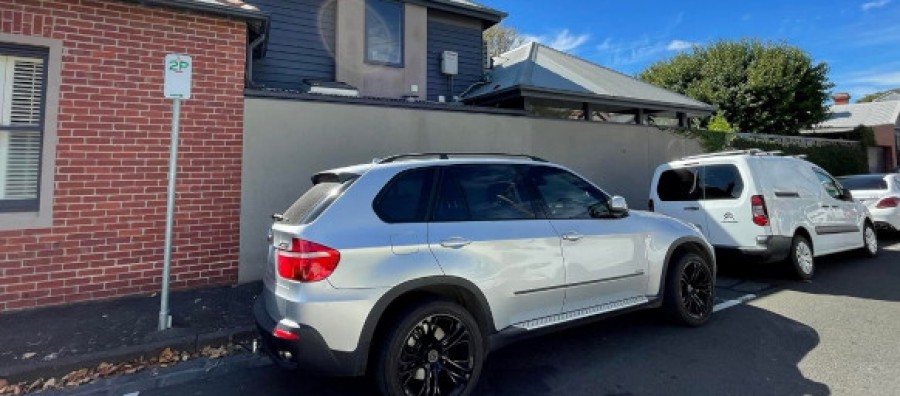
Residents report failure of the new parking and traffic arrangements for the 2022 Australian Grand Prix. City of Port Phillip and the Australian Grand Prix Corporation (AGPC) trialled new parking and traffic arrangements for the 2022 Grand Prix. The aim was to minimise the impacts of the Grand Prix on local residents and businesses. Information about parking and traffic management is published on the COPP website:
https://www.portphillip.vic.gov.au/council-services/traffic-roads-and-transport/grand-prix-parking-and-traffic
The new approach to traffic management included replacing the previous physical barricades around Middle Park and Albert Park with temporary parking changes to 2P Thursday 7th April to Sunday 1oth April 8 am to 6 pm to discourage GP visitors from parking in residential streets. Properties within the affected area received two temporary parking permits to exempt them from the temporary parking changes. The trial aimed to provide ease of access to residents and visitors to local businesses, schools and community centres while limiting the impact of GP visitors on our local streets.
Greg, an Albert Park Families resident made a complaint to the City of Port Phillip of an illegally parking car during the Australian Grand Prix using the Snap, Send Solve app, the COPP informed him that the attending infringement officer was “unable to enforce (the parking restriction) as the signage was not conforming”. The non-conforming sign was actually a temporary sticker placed over a no stopping sign. One resident commented “Port Phillip Council employed contractors to put these signs up and now won’t enforce the 2-hour parking. What a farce!”
Source: Greg Cassano – Albert Park Families 3206 Facebook Post 10th April 2022
Sarah Stone, a Middle Park reported visitors removed the temporary 2P stickers applied to the existing unlimited parking and parked all day in Richardson Street without receiving infringement notices. When Sarah advised COPP that the temporary stickers had been removed, she was informed the signs would shortly be reinstated and infringement officers would be in attendance. Sarah said, “The signs were finally amended in Richardson Street but in some cases were applied so badly that they did not cover the unlimited P sign which we discovered later meant that infringement notices could not be issued”. We understand that every time the temporary stickers were re-applied to the existing signs the stickers were removed and consequently few infringement notices were issued.
Residents were also impacted by taxis and rideshares dropping off and picking up customers in Richardson Street either side of Armstrong Street. The volume of traffic was enormous compared to prior years when Richardson Street was not used as an unofficial pickup and drop off location for taxis and rideshares and the volume of traffic was not a problem as it was a local access area only.
One resident who displayed permits on the incorrect side of the dashboard was fined. This is just petty and nasty especially when the City of Port Phillip has botched the design and execution of the temporary signs.
During COVID-19 lockdowns, a local Port Melbourne community built a BMX track at RF Julier Reserve. The track was removed for public safety, and Council received a petition for it to be maintained. In response, Council is proposing to build a BMX pump track within the local area.
Council has identified Garden City Reserve near the children’s playground as the most suitable location for the pump track. Port Phillip Council is consulting with the local community on the proposed plans for an asphalt track to maximise safety for bike and scooter riders. For more information refer to Port Phillip Council’s website: https://haveyoursay.portphillip.vic.gov.au/bmx-track-2022
Residents opposing the proposed BMX pump track in Garden City Reserve, say the open "passive" green space is used daily for family picnics, dog walkers, solitude seekers and young children playing in the dragon playground area and is not suited to an asphalt BMX track. A local resident Ramona Headifen has started a petition which states “This seems dangerous to promote such a track next to a children's playground. The track is likely to see users riding at high speed, chasing each other in the area, and again this is not conducive near to children playing and family picnics. The track could become a hang out area similar to the skateboard park under Graham St”.
Another resident, Megan Jones who also opposes the desecration of the Garden City Reserve told us “There already exists two purpose-built BMX Pump Parks in Port Melbourne. One is located at Turville Reserve which is gravel and neglected but could be revived by COPP. Turville Reserve is adjacent to the Port Melbourne skatepark on Station Street. The other is a newly built BMX park is in Westgate Park but not part of COPP purview, so it is ignored even though it is within 1 km of the proposed new venture”. Megan Jones also said that “the Council’s project manager did not appear to know the Council has a signed contract with the Hobson's Bay Obedience School for dog training in area promised to the BMX park”.
If you don't want Garden City Reserve to become home to this track, please sign this petition.