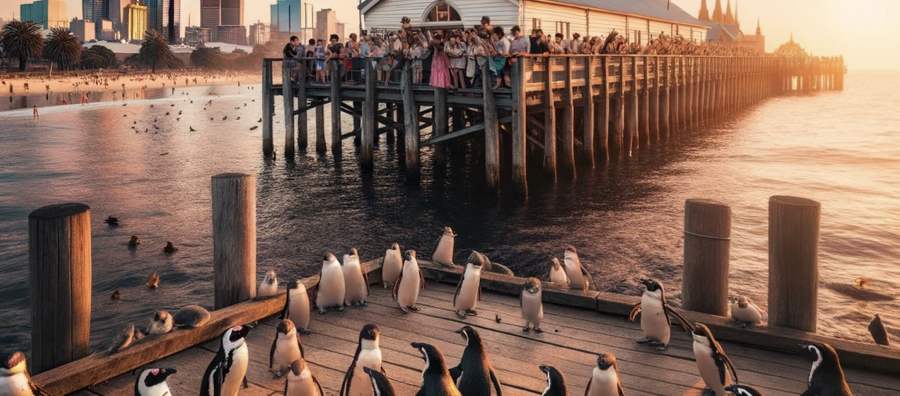
In the bustling metropolis of Melbourne, the St Kilda Pier serves as an urban oasis for weary city dwellers seeking a glimpse of nature's majesty. Home to a thriving community of 1,300 Little Penguins, the breakwater has become a sanctuary not only for these marine birds but also for the city's residents and tourists. The confluence of concrete and ocean, skyscraper and sky, meets its most tranquil counterpart in the sight of these penguins returning to their burrows each evening.
However, Parks Victoria's recent proposal to monetise this experience through a pay-per-view scheme for the penguin colony raises important ethical and economic questions. As they undertake a $53 million redevelopment of the pier, officials are eyeing entrance fees that could range from $30 for tiered seating to $95 for a guided ranger tour, akin to the prices at Phillip Island's penguin parade. While the government purports that charging a fee will enable better management of visitor numbers and, by extension, the penguins' well-being, we must ask: should access to Mother Nature come at a cost?
The Dystopia of a Privatised Foreshore
Dubbed by critics as "CityLink for penguins," this move towards monetising access to natural beauty risks creating a dystopian future where the splendours of nature become gated communities for the financially privileged. Many argue that the foreshore should remain a common good, open to all, especially when it serves as one of the few free recreational opportunities for lower-income families. Volunteers have managed the penguin viewing experience with nothing but passion and commitment; their efforts should not be commodified.
The Economic Fallacy
From an economic standpoint, monetising public goods often leads to an inefficient allocation of resources. The marginal cost of allowing one additional viewer to witness the penguins is practically zero, yet the proposed fee creates an artificial barrier to entry. This is hardly an example of market efficiency; rather, it reflects a short-sighted grab for revenue at the expense of societal welfare.
The Social Contract Revisited
While the State has a duty to conserve and manage natural resources, this responsibility should not extend to erecting paywalls around public spaces. Governments are caretakers, not landlords, of our natural heritage. If the goal is to manage crowd size for the benefit of the penguin colony, then timed entries, a reservation system, or even a donation-based model could achieve this without excluding those who cannot afford the fee.
Environmental Stewardship Over Profit
Local St Kilda resident and long time reader asserted that “at a time when families are facing cost of living pressures and wanting a fun day in St Kilda, the fee proposal is the last thing that should be on Parks Victoria’s radar.”. He went on the say “We all know what happens to fees anyway. It starts with good intentions, but nothing ever is reinvested. It all ends ups in consolidated revenue.”
There are numerous ways to ensure environmental protection without commodifying nature, such as through better crowd management techniques, increased public awareness, and reinforced regulations against harassment of the penguins.
In a world increasingly dictated by market forces, the tranquility of a Melbourne sunset and the simple joy of watching penguins waddle home should remain priceless. To put a price tag on such experiences would not only be unfair but also profoundly unwise.
Thus, as stewards of both natural and economic ecosystems, our governments should resist the temptation to turn public wonders into private commodities. The penguins, and indeed the broader principle that access to the wonders of Mother Nature should be free, are worth far more than the sum of their potential admission fees.
Port Phillip Matters (PPM) has received much interest in this matter. Jenni Roper, local St Kilda resident, has summed up her thoughts on this:
"The pressing question at hand is the amount Parks Victoria plans to charge for viewing the penguins. There must be transparency on their part in communicating not only the cost but also the allocation of these funds. Specifically, how will the revenue benefit the local environment, the community, and the penguins themselves? Penguin-watching has apparently become a lucrative venture. As a 23-year resident of St Kilda, I've always considered it a privilege to take my children and visitors down to the pier to see the penguins, all without incurring a fee. This has been an integral part of our local community experience. I sincerely hope that Parks Victoria will refrain from charging local residents. However, if large tour buses start to frequent the area, as they do at Phillip Island, a nominal fee could be levied, provided that the collected funds are channeled directly into educational and conservation initiatives for the penguins."