In well-run private sector companies, there is usually evidence of very strong key performance indicators (KPIs) that measure the efficiency and delivery of services to their stakeholders. The primary stakeholder is the shareholder, who monitors their investment through the successful (or otherwise) delivery of key performance measurements.
In the case of a government entity like the City of Port Phillip (CoPP), we, the ratepayers (both business and property owners), and those who reside in Port Phillip are shareholders and stakeholders. However, what most of us do not know is what KPIs drive the City of Port Phillip. Without substantive regularly published metrics of ongoing performance against indices based on community expectations, how do we create greater efficiency and service delivery?
The CoPP has some high-performance metrics, but they are rarely published, and if so, usually in the end-of-financial-year statements. Many are concerned that there has been no consultation or engagement with the community stakeholders in how the KPI metrics have been formulated, what should be encapsulated for measurement, and expectations of regular, transparent communication of performance against key benchmarks.
When we consider that the business of local government in Port Phillip constitutes annual expenditure of $250 million, there is an urgent requirement to strengthen performance and governance of funds expended, especially when evidence of delivery failure is becoming more apparent.
The Victorian Community Satisfaction Survey is an annual survey, conducted by JWS Research*, that collects opinions from local people about their community. It provides insight into various aspects of the community's views and has been conducted for 23 years. The survey helps councils measure their long-term performance and improve services to meet the public's expectations. A recent summary of Port Phillip City Council performance by JWS threw up some alarming results, including:
- 64% overall performance
- 56% value for money
- 47% council direction
- 54% community consultation and engagement
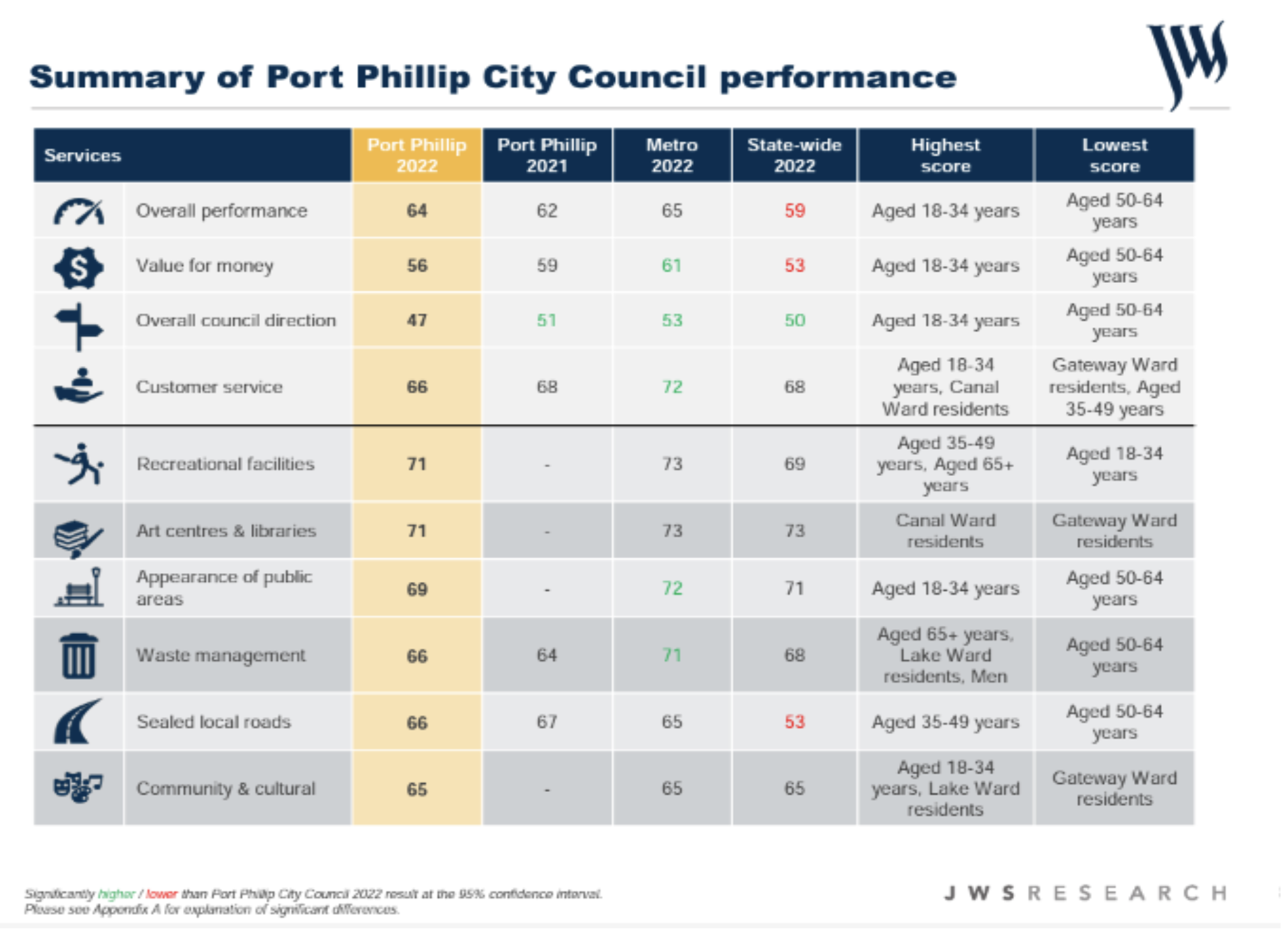
Similarly, with large sums of money entrusted by the stakeholders, potential waste and spending on non-core issues also come. “Bread and butter” matters that should form the large bulk of any expenditure and measurement are often in competition with “pet projects” of little economic or social benefit. Councillor “pork barrelling” and, more worryingly, the potential loss of councillor independence through directives from Spring Street that may not necessarily be in the interests of all ratepayers, needs greater scrutiny. Therefore, we can assume that these are some of the reasons contributing to the poor rating for community decisions at 55% in the survey.
Ask yourself these questions
- In the past, CoPP phones were answered almost immediately. However, this is no longer the case, with often many minutes passing before being answered by an operator. The deeper question is why have calls to the CoPP increased significantly? I doubt whether this is a consumer trend, with the likely answer that delivery of services has fallen, and more of the citizenry as a result are chasing up slow, backlogged, or non-delivered services.
- What is the policy of staff working from home in the CoPP? What are the current average days that staff work from home? Is it being properly managed? Should there be a demand that staff return to full-time work in the office, where productivity and on-hand delivery of service can be better measured and supervised? What metrics should be employed and published?
- The basic car park permit: I lodged my application over two years ago and still have not had a response. Others have expressed similar experiences.
- Rubbish collection is another area of concern where household rubbish is often missed on the designated day of collection. While there has been a reason proffered on why (lack of collection drivers), how common is this occurrence, and what percentage of rubbish is collected on time? If there are measurements on rubbish collection performance, the statistics do not appear regularly or transparently.
- Let’s look at a real bugbear of residents: household items dumped on footpaths. Using the ‘Snap Send Solve’ app, how many of us have received an email from the CoPP to rate the collection service that was never undertaken in the first place? During a recent use of Snap Send Solve, the collection was only half completed, requiring a further call. Is there a need for a review of this service, and is there potential for excessive billing? Do we have access to real collection rates and turnaround times? Are the CoPP's metrics on this published?
- Property Planning and Building permitting are also a concern. How many permits are issued or reviewed within the stipulated timeframes, including initial responses to submissions? Are turnaround times being stretched because the CoPP knows that any applicant for a permit will be reluctant to escalate through VCAT with up to 18 months turnaround times for a VCAT decision?
- Are the efficiency metrics of turnaround times accessible?
Moving forward, there needs to be a full community consultation on our expectations for Key Performance Indicators for the City of Port Phillip. Such a bottom-up process that builds a series of metrics and reporting criteria is the first step in determining not only how well the CoPP is performing but also in providing data for the Councillors, executives, and staff to undertake continuous performance review and improvement. With a new CEO now in the seat and inheriting the poor performance statistics, now is the perfect time for a review.
Rod Mitchell
Ratepayer St Kilda
* JWS Research is a research firm that provides advice to the government and business sectors in Australia. They conduct research by listening and exploring the community to uncover strategic insights. The firm has been operating for over a decade and is respected in the industry for providing evidence-based advice.