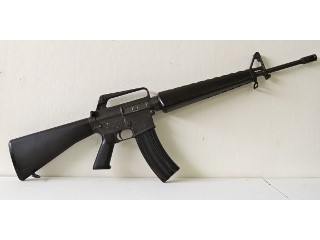
The M16 rifle used in the Vietnam war was a Colt-manufactured adaptation of the AR-15 rifle, produced by ArmaLite. The M16 was often called an ‘Armalite’. The rifle was adapted for semi-automatic and full-automatic fire. It entered United States Army service and was deployed for jungle warfare operations in South Vietnam in 1963, becoming the U.S. military's standard service rifle of the Vietnam War by 1969.
The M16 is a lightweight, 5.56 mm, air-cooled, gas-operated, magazine-fed assault rifle, made of steel, aluminum alloy, composite plastics and polymer materials.
In the early 1960s, the U.S. Army standardized an upgrade of the first issue as the M16A1 rifle, an M16 with a forward assist feature, to counter the bolt jamming, and other improvements requested by the Army. The first M16s were issued in 1965 and the modified improved M16A1 in 1967
This version remained the primary infantry rifle of U.S. forces in South Vietnam until the end of direct U.S. ground involvement in 1973. They were also issued to Australian forces, especially for forward scouts and radio operators.
They weighed only 4 kilograms fully loaded, held a 20 or 30 round magazine and had an effective range of about 500 metres.