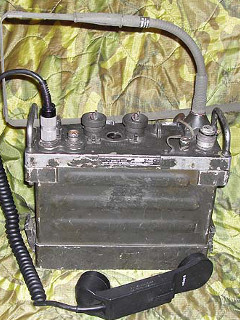
The major field radio of the Vietnam War was the A. N. / P. R. C. 25. It weighed 23.5 pounds or 10.6 kilos.
The radio was tough and would easily survive a 50 foot fall from a helicopter onto a metal-planked runway. It could be completely submerged in water for an hour, and still work. It could be battery powered for use as a backpack radio, or it could be plugged into an external power source for use in a vehicle or a helicopter. For infantry use, one per platoon, it was issued with its own pack frame.
The radio's weak point was the communications handset. The handset could simply not get wet. In a wet, humid, country like Vietnam, this was a serious problem. The usual way to deal with this was to put the handset inside the clear plastic bag, tied in place with a rubber band. For all that, the microphone was fairly sensitive and could even be whispered into.
The radio had a transmission range, with the short antenna, of about 3 to 4 miles or up to 5 kilometres, but various terrain factors could influence this. The long range antenna was supposed to be good for up to 18 miles or 29 kilometres.
The battery was good for about a day of casual operation, listening mostly, some occasional transmissions. In a period of intense use, transmitting/receiving all the time, it was good for perhaps 2 to 3 hours. When expended, the battery pack had to be physically destroyed. Inside were flashlight-type batteries which the Viet Cong could use in booby traps. Spare batteries were carried by the operator and others spread through the infantry platoon