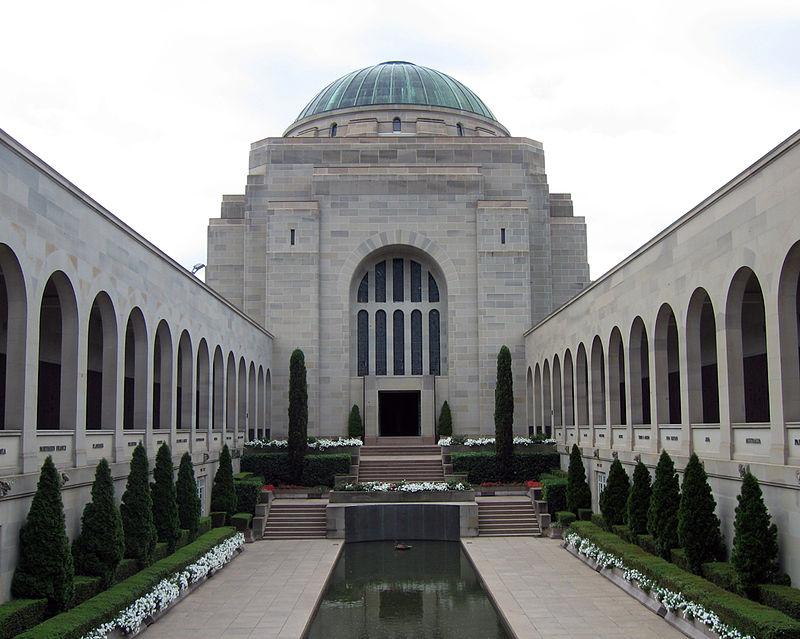
The Australian War Memorial combines a shrine, a museum, and an extensive archive. The Memorial's purpose is to commemorate the sacrifice of those Australians who have died in war.
The Memorial was allocated a budget of £250,000. An architectural competition in 1927 failed to produce a satisfactory single design for the building. Two of the entrants in the competition, Sydney architects Emil Sodersteen and John Crust, were encouraged to submit a joint design. The joint design was accepted and forms the basis of the building as it is today. The memorial was completed and opened to the public on Remembrance Day, 11 November, in 1941.
Two men, above all others, shaped the Memorial: Charles Bean, who became Australia's Official Historian of the First World War, and John Treloar, the Director of the Memorial between 1920 and 1952.
Charles Bean (1879–1968) was born in New South Wales but grew up and was educated largely in Britain. He returned to Australia and worked as a journalist, and in 1914 was chosen by the journalists' association as official war correspondent. Bean went ashore during the landing on Gallipoli on 25 April 1915, and for the rest of the war followed the movements and battles of Australian soldiers. As well as conceived and lobbied for the creation of the Australian War Memorial.
John Treloar (1894–1952) contributed more than any other person to the realisation of Bean's vision. Treloar also landed on Gallipoli on 25 April 1915. In 1917 He was appointed to head the new Australian War Records Section in London. Treloar was responsible for collecting records and relics for the future museum and to help the official historian in his work. After the war Treloar devoted his life to the Memorial, and influenced almost every aspect of its development. He was appointed Director of the Memorial in 1920 and remained in this position for the rest of his life except for a brief period during the Second World War.