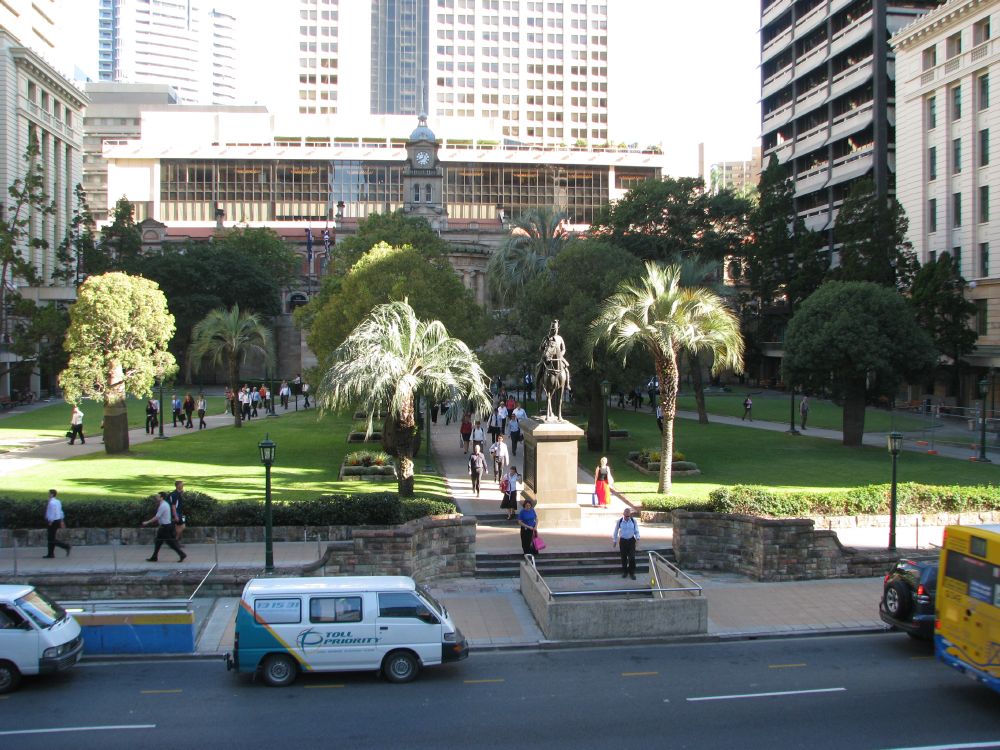
Chinese (Simplified) Chinese (Traditional) English French German Greek Hindi Indonesian Italian Japanese Korean Malay Spanish Vietnamese Print New Tab ANZAC Square; Queensland Womens War Memorial Brisbane Australia's involvement in World War I exacted a heavy toll in death and injury. Of a relatively small population of about five million people, 60,000 troops were killed and 152,000 wounded. Australia's casualty rate of 68.5% was the highest of the Allied forces. The idea of a large memorial park and monument in the centre of the city commemorating those who had participated and died in the Great War was first raised in 1916. The original plan was to use the whole city block bounded by Ann, Edward, Adelaide and Creek Streets for the Square but as negotiations with Federal, State and local governments continued throughout the early 1920s, a smaller site was determined. In 1928 State and Federal governments agreed to grant lands for the Square and to erect flanking buildings to a co-ordinated design. Anzac Square commemorates all Queenslanders who participated in war, not just Brisbane residents. In 1928 a competition for the design of a Shrine of remembrance was won by Sydney architects Buchanan and Cowper. Construction proceeded over the following two years and on Armistice Day 11 November 1930 the Governor Sir John Goodwin dedicated the Shrine and the Square. In 1933 the Square was declared a Reserve for Park purposes and the Brisbane City Council was appointed trustee of the site. In 1932 the Queensland Womens War Memorial was unveiled. This memorial was an initiative of the Brisbane Women's Club and funded by public subscription. It was designed and executed by Daphne Mayo with assistance from George Harvey. A memorial commissioned by the 9th Battalion (AIF) Association was mounted in the Crypt and unveiled by the Governor-General Lord Gowrie on 17 August 1937. Commemorating the battalion's 45 officers and 1048 other ranks who lost their lives in the war, it was undertaken by former Brisbane sculptor W Leslie Bowles at a cost of £500. Bowles was noted for his memorial work, having been head sculptor at the Australian War Memorial in Canberra during the years 1924 to 1931. In 1939 a memorial commemorating Queenslanders who served in the South Africa conflict 1899-1902 was relocated to the Square. This memorial, featuring a fully equipped mounted trooper originally stood near the intersection of Turbot and Edward Streets. It was designed by James Watts and sat on a pedestal constructed by local firm Lowther & Sons. During the 1960s and 1970s various proposals were made to alter the Square as part of the redevelopment of property on the opposite side of Adelaide Street. These plans met with considerable public resistance. After a protracted public debate, a compromise plan involving limited encroachment on Anzac Square was agreed upon. This work was completed by 1984 and included the construction of a pair of elevated pedestrian bridges to Post Office Square, enlarging the crypt under the Shrine, and the realignment of the Adelaide Street entrance to the Square. Originally envisaged as a First World War memorial, Anzac Square has become a repository for memorials of other wars. In 1984 the Second World War Shrine of Memories was relocated in the enlarged crypt under the Shrine and during 1988 memorials to those who served in the Korean and Vietnam wars were erected in the square. Anzac Square remains as the focus of armed services commemorations, particularly on Anzac Day. Contributor Author90 90, Author, Attribution Queensland Government Heritage Register Attibution: © The State of Queensland 2016 License: CC by 3.0 AU https://www.qld.gov.au/legal/copyright/