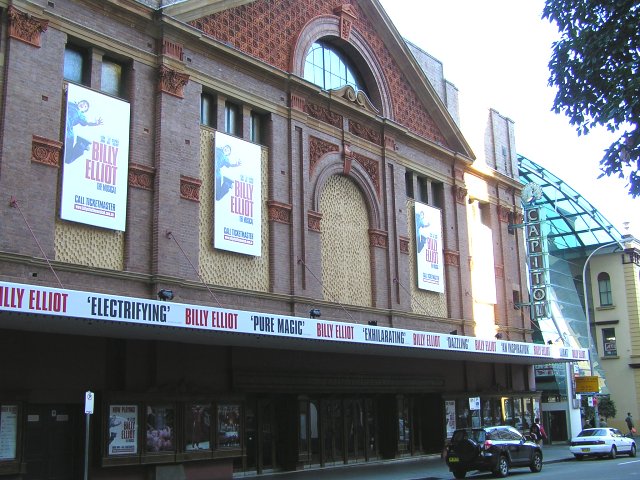
Chinese (Simplified) Chinese (Traditional) English French German Greek Hindi Indonesian Italian Japanese Korean Malay Spanish Vietnamese Print Capitol Theatre Building Sydney 01 Jan 00 Designed by Henry White and John Eberson and constructed and varied over 1893 to 1928.Timeline:1893 - Belmore markets completed. 1913-1917 - redevelopment and conversion to Hipporome. 1927-1928 - conversion to Capitol theatre. 1933 - 1972 - interiors gradually stripped. 1972 - atmospheric and ornamental fabric removed and altered. 1990s - restored and reconstructed. During the 1880s facilities for the bulk sale of fruit and vegetables came under increasing pressure. In March 1891, Sydney Council appointed a committee to recommend a new site for a major covered market. They suggested the adjacent space of the Haymarket and this proposal was adopted in the following July. The principal contractor for the building was Alexander Allen of Summer Hill and his tender of 24,902 pounds was approved in November 1891. The markets opened in July 1893. The New Belmore Markets as it was called was designed by George McRae. The facade presented thirty-six arched bays to the streets: eleven to Campbell and Hay and seven to Parker and Pitt. The New Belmore Markets was not an economic success and led Council to seek alternative uses for the building. In 1912 the New Belmore Market was leased for ten weeks to Wirth Bros for the purpose of a circus and hippodrome. Council decided to recycle the fabric of the New Belmore Market to create a theatrical circus venue. In September 1912, the Council accepted Wirth's tender for a twenty-one year lease of the proposed Hippodrome. The conversion was under the control of Robert Hargreave Broderick. The facade was dismantled and re-erected above a new ground storey which was in turn mounted on the old footings. The redevelopment was split into two major contracts: the eastern half now known as the Manning Building was awarded to J. M. & A. Pringle in May 1913 and the Hippodrome theatre to the west to William Maston and Thomas Yates in December the same year. The Hippodrome finally opened in April 1916. Despite the Hippodrome's versatility, it was not a financial success and by 1926 Wirth's had decided to seek the remodelling of the buildings as a picture palace. Plans for the work were completed by Henry White in February 1927 for 'Capitol Theatre Sydney Limited' and the same month Wirths wrote to the Sydney City Council requesting a 'remodelling' of the building for its proposed new function. Henry White was a very experienced theatre designer and in 1927 visited America with Stuart Doyle, the managing director of Union Theatres Ltd., to review the latest developments in theatre design. Whilst in the United State, architect John Eberson was engaged to provide White with designs for the conversion of the Hippodrome. The plans for an atmospheric auditorium were very much like Eberson's Riviera at Omaha, Nebraska. The conversion involved remodelling the interior and raising the roof trusses to make room for the atmospheric ceiling and extended slope of the new gallery. In May 1927, the Sydney City Council approved Wirth's proposed alterations. The Capitol opened on the 7th April 1928. In 1929 the theatre was fitted to screen talkies but by 1932 Greater Union was in financial difficulties with the Depression. In November 1932 the Capitol closed its doors. It re-opened in April 1933 screening second-rate movies. Maintenance economies gradually put machinery and lighting out of action and in 1945 all 'unwanted' decoration including banners, tapestries and artificial foliage was stripped from the interiors. In 1972 the theatre lease was removed from Greater Union Theatres and awarded to Harry M. Miller for the production of Jesus Christ Superstar. At that time the atmospheric and ornamental fabric was removed. During the 1990's the lease was transferred to Ipoh Garden Developments Pty Ltd. At this time the Capitol Theatre underwent a detailed restoration and reconstruction to recover the original 1928 experience. It has now been returned to its original grandeur. Contributor Author90 90, Author, Attribution NSW Heritage Register Citation/Attibution: © State of New South Wales and Office of Environment and Heritage 2017 License: CC by 4.0 http://www.environment.nsw.gov.au/help/copyright-disclaimer.htm