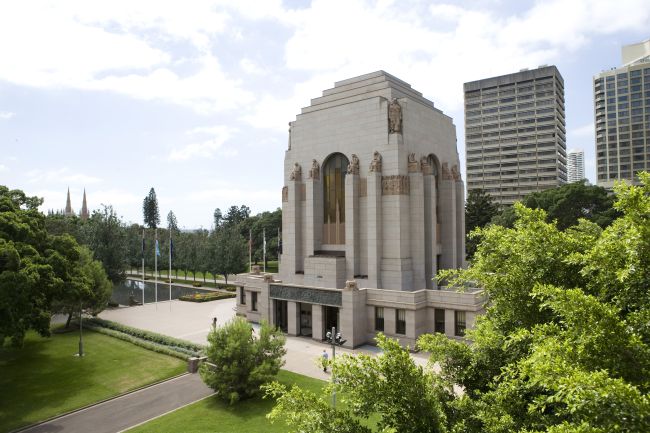
The ANZAC Memorial, completed in 1934, is of historical significance to the State for its embodiment of the collective grief of the people of NSW at the loss of Australian servicemen and women since World War I. It is associated with the landing of Australian troops at Gallipoli on 25 April 1915. The Memorial is a principal physical focal point in the axis joining it and the Pool of Reflection with the Archibald Fountain in Hyde Park north.
The memorial is adorned externally with many sculptures representing the various Australian armed forces and support units. They are the sentinels of the building, keeping watch whilst representing the fallen for whom the building is dedicated. Between the seated figures in each corner are cast stone bas reliefs. The four large standing figures at the top of each corner of the building represent the Australian Infantry, Navy, Air Force and Army Medical Corps. Another 16 seated figures are positioned at the top of the buttresses, below the corner figures, and represent the various units. These statues include a Naval Signaller, Aviator, Nurse and Lewis Gunner fabricated from cast stone to resemble the granite facing of the building 'so they should have the effect of having been hewn out of the moment rather than placed thereon'. Above the Eastern and Western Entrances, bronze bas reliefs depict scenes of Australians in the Eastern and Western Fronts.
The Hall of Silence located in the centre of the building is striking in its starkness and wields a powerful influence on visitors. The sculpture 'Sacrifice' is located at its centre, as if to hold the sculpture in its embrace. The ceiling of the room curves up toward the carved marble banister that defines the 'Well of Contemplation', a large circular opening in the centre of the shallow domed ceiling. This opening provides the only natural lighting to the 'Hall of Silence' and has the effect of focussing that light onto the central sculpture.
At the heart of the memorial is the bronze sculpture, 'Sacrifice', by Rayner Hoff. It symbolises the sacrifice made in times of war by both those who go to fight and those left behind.
The 'Hall of Memory' occupies the podium level of the building centred on and located directly above the 'Hall of Silence'. Located in the four 'corners' of the room are semi-circular 'Niches of Remembrance', each devoted to one of the major theatres of World War I in which Australians fought, and each commemorating the names of major campaigns in those theatres. The name of the theatre is carved in relief into the face of the marble wall at the top of each niche with the names of the battles beneath it. At the base of each niche, laid in the paving is a headstone from Flanders, Gallipoli, Palestine and New Guinea.
Above the tall niches are marble cast bas reliefs by Rayner Hoff that represent the Army, Navy, Air Force and Army Medical Corps and therefore correspond to the four large standing external sculptures. Hoff called them 'The March of the Dead'. Above all this is the high soaring dome of the ceiling covered with 120,000 stars, one for every man and woman in New South Wales who served in the Great War, made of plaster of paris and painted gold leaf.
To the east is the Remembrance Flame Room, originally the Archives Room and intended to list the names of those 21,000 New South Wales men and women who died serving their county in the Great War. Over the doorway is carved 1914, 1918 and above that is a winged flaming sword (a symbol of sacrifice) over a rising sun emblem. The room holds the Remembrance Flame that was first officially lit on the 11th of November 1995. The Great Doors to the room are left open to keep the flame exposed to view at all times.
The exhibition space occupies the southern office area. Items displayed in the museum collection were donated by the public and include personal letters, medals, books, diaries, uniforms, souvenirs, relics and banners relating to the various c