
Did you know the ball with which one bowls in lawn bowls is “biased”. This means one side is flattened. As if life isn't hard enough!
The nuance of the physics in this distributed weight anomaly is beyond this author. But the result is that the bowl follows a curved horizontal trajectory when rolled, something like the curve of a banana laying down.
Could it be that the inventor of bowls always bowled off to one side and so invented a non-spherical ball (termed bowl) to compensate? Subsequently, all those that followed had to deal with this. The ever dependable Encyclopedia Britannica informed me that a form of bowls was played in ancient Egypt. Moving forward a millennia or two, the ruling body of today's form of lawn bowls - the International Bowling Board - was founded in 1905.
But back to the balls, or in this case the bowls. The concept of a biased bowl leaves this author somewhat discombobulated. Can you imagine the same physics being applied to ten pin bowling? The lanes would have to be three times wider. What about playing golf with a ball that is biased. One spends too much time looking for a ball the size of your eye as it is - whereas in squash one spends time avoiding being hit in the eye with a ball just the right size to replace it.
Some counties in England play a variation named Crown Green Bowls. In this version, a square area with a raised hump (aka crown) is located in the centre
of the green. If that doesn’t add sufficient challenge, the surface of the green can also be uneven – just for a little more random excitement. At least here in AUS our greens are flat, true and generally surfaced with beautifully manicured grass or Astro turf. I must say the latter sounds a little like something the Jetsons would be using to play this game.
Whatever they were thinking (or drinking) when the governing body decided the rules, the result is a sport which is not only highly enjoyable but also very social. I tried my luck at bowls as did my children. We found ourselves engaged in what was for us initially a game of chance, largely due to the fact we had no skill in this discipline. But it was great fun from the first bowl to the last. And social! I cannot think of another ball game where one can equally enjoy the social aspect throughout the experience as well as the sporting competition.
All in all, can I recommend bowls to others? You bet! Would I recommend bowls as a family activity? You bet! So armed with this considered research, why not pick up the phone, call your local Auburn Bowls Club on 9882 2138.and give the casual “Barefoot Bowls” a try.
Auburn Bowls Club is located at 2B Munro St, Hawthorn East VIC 3123
Website: https://www.auburnbowls.org.au/
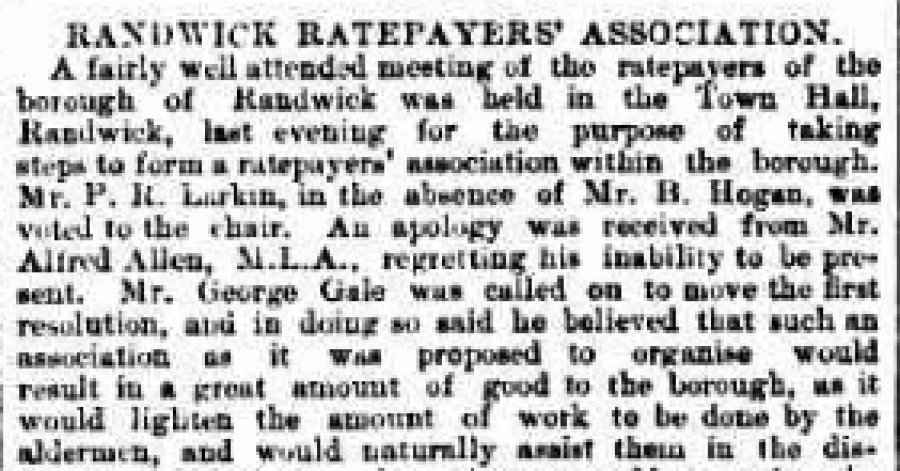
Ratepayers Associations: a good idea back in 1888 and a good idea now
It’s Sat 21 Jan 1888 and we're reading The Sydney Morning Herald:
A fairly well attended meeting of the ratepayers of the borough of Randwick was held in the Town Hall, Randwick, last evening for the purpose of taking steps to form a ratepayers' association within the borough. Mr. P. R. Larkin, in the absence of Mr. B. Hogan, was voted to the chair. An apology was received from Mr. Alfred Allen, M.L.A., regretting his inability to be present. Mr. George Gale was called on to move the first resolution, and in doing so said he believed that such an association as it was proposed to organise would result in a great amount of good to the borough, as it would lighten the amount of work to be done by the aldermen, and would naturally assist them in the discharge of their duties. Its existence would strengthen the hands of the council, and would have the effect of causing the money of the municipality to be rightly handled and fairly distributed. He hoped that the operations of the association would at no time grate against the feelings of the aldermen, but that the council and the association would work in harmony with each other. He concluded by proposing "That a Ratepayers Association he formed," which was seconded by Mr. Isaac Hodgson, and supported by Messrs. George Wall and George Young (Balmain), and carried without dissent.
The meeting then resolved itself into a committee of the whole to discuss rules, a code of which was unanimously adopted. The public meeting was subsequently resumed and the election of officers proceeded with which resulted as follows:-President, P. R. Larkin; vice-president, James Middleton; treasurer, John Maynard ; secretary, D. A Thomas; committee, Messrs. O. Wall, George Gale, James Service, Thomas Payten, and H. Holcomb. The objects of the association are to watch the progress of all works and matters connected with the Municipality of Randwick, and to consider and discuss the same, and generally to promote a knowledge of and interest in municipal and other matters affecting ratepayers and residents of the borough.

It is an odd thing but in bad times (like these) the book trade becomes busier than ever. This has been the experience of my friend Nick Walker who runs Australian Scholarly Publishing and he tells me ‘the demand for services we modestly provide seems to grow.’
I believe him. Covid has given me the opportunity to make a small contribution to his workload and hence to the book trade in general. A few blocks away from me my mate Mike Rosel has had one Covid- time book published (about his war hero father at Tobruk) and has another in the works. It would be interesting to learn how many people in the circulation area of this publication have produced – or are currently writing – memoirs, biographies, maybe a novel.
In my own case Covid presented the opportunity to devote several hours every day to researching the life of Peter Ryan, war hero, book publisher, acclaimed writer. The result is Ryan’s Luck: A life of Peter Ryan MM. (Arcadia). Ryan, who died in 2015 at the age of 92, was a truly remarkable Australian. As a 19- year- old soldier he was awarded the Military Medal for his work behind Japanese lines in New Guinea during World War 2.
On his return to Australia (and not yet 21) Ryan wrote Fear Drive My Feet, recognised as perhaps Australia’s finest war memoir. In a long life of achievement, controversy and mischief he was Director of Melbourne University Press for 26 years, an Officer of the Supreme Court of Victoria and an outspoken newspaper and magazine columnist. I knew Peter Ryan in the final decades of his long life and liked him enormously. He was very helpful to me on an earlier project involving his great friend the journalist and academic Creighton Burns.
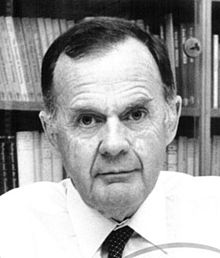
Peter Ryan at MUP
For a long time now I have been convinced of the importance of always having a “project” underway; at least one. It certainly gives added purpose and focus to daily life. It would be premature to report what my current project entails. But it is certainly keeping me occupied during the latest phase of covid with all its irritations and restrictions.
Author - John Tidey


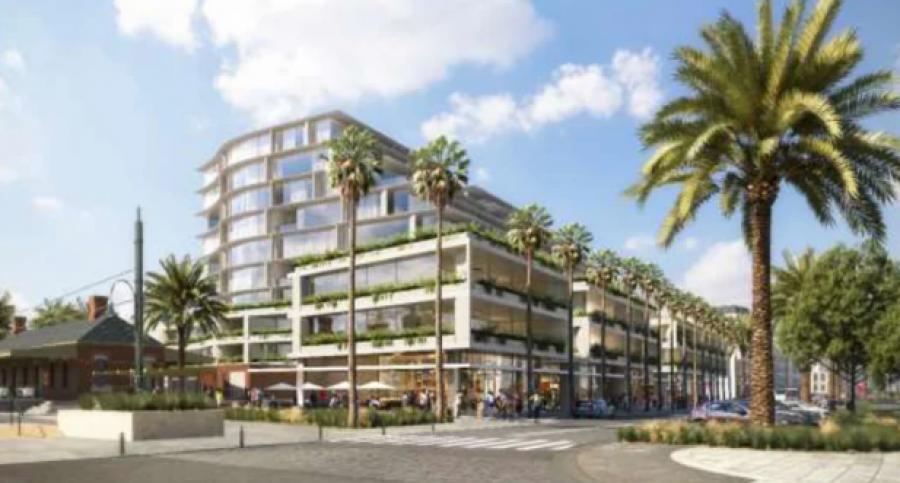
On 24 June, the Port Phillip Planning Committee released their 97-page report regarding an application for the construction of a 10 story building with 119 apartments, retail shops including food and drink premises, a wellness centre, gymnasium and a reduction in car parking requirements. The location at 1-7 Waterfront Place, Port Melbourne, has significant Beach Street frontage.
The report makes for interesting reading for the breadth of considerations, objections and Planning Officer’s responses and conclusion methodology. I shall leave it to you, the reader - who is likely local to this development - to draw your own conclusions regarding two matters that stand out:
- The Planning Officer's conclusion with respect to parking: and
- The Planning Officer's process for conclusion with respect to shadows.
Parking
The report states: “The development is not considered to result in a significant impact upon the road network. The development would provide parking spaces in excess of the requirements of the Planning Scheme. However, due to the way parking would be allocated (no parking allocated to customers of the commercial uses), a parking waiver is sought for the customer component of the parking requirements. The parking waiver is well justified and not considered to result in any undue offsite impacts.” 2.10, page 2
After reading this report, I visited Bay St, Port Melbourne. Bay St is one of jewels of Port Melbourne, with a bustling retail trade. It is very clear that the retail shops on Bay St do require car parking spots for their customers, and due to the strip's popularity, it can sometimes be difficult to find a car parking spot.
It is difficult to reconcile the council's position that retail facilities at Waterfront Place do not require additional car parking (page 49). The report asserts that the retail outlets will only service users who are “typically be in the area already, rather than driving to the Site”. Does this mean walking distance from their home? One must wonder if the future retail tenants will be willing to pay significant commercial rents in an area that only services the population in the building and residents within walking distance. Hopefully, this will not result in untenanted retail shops which will bring a ghost town feel to this new development.
It is also puzzling that council asserts that no visitors parking permits will be required and thus will not be available to any of the 119 dwellings (page 15 Permit Notes): "The owners and occupiers of the new dwellings allowed by this permit will not be eligible for Council resident or visitor parking permits."
Furthermore, and more importantly, it seems the developer is not required to make provision for visitor parking. One can only assume the Planning Officer is of the opinion that all residents will have very limited social life and no carers tending to their needs.
Shadows
The requirement for this building is that "Development should minimise overshadowing beyond the southern kerb line of Waterfront." (Requirement B8 page 75).
The Planning Officer's response to the proposed design is:
- "A detailed assessment in terms of winter shadows has been provided at section 13.4 of the Report; ultimately, they are considered to be acceptable." (page 52)
- Firstly, it is noted that the requirement is discretionary, stating that development should minimise overshadowing. Secondly, whether shadows are ‘minimised’, is ultimately a matter of judgement. It is clear, based on the planning controls, that a 10 storey development which delivers medium to high density housing has been contemplated for the Site, it is within this context that the term ‘minimised’ must be viewed. (B8, page 70-71)
- Furthermore, it must be acknowledged that some level of shadows are inevitable from any development, particularly one of 10 storeys in height (B8, page 70-71)
To this observer, the reasoning offered by the Planning Officer (in bold) does not contribute to the veracity of conclusion reached by the Planning Officer.
As is usual with planning applications, often the most sensible observations come from the general public. One astute objector responded: “...Reiterated concerns relating to winter shadows. In addition, bike and pedestrian paths along Waterfront Place are predominantly in shadow between 9 am and 3 pm at the June solstice, this is not consistent with the requirements of the DDO. …" (Public Notification/Objections, page 52)
So what did the Planning Officer recommend?
Planning Officer's Recommendation
RECOMMENDATION PART A, page 3
"3.2 That the Responsible Authority, having caused the application to be advertised and having received and noted the objections, issue a Notice of Decision to Grant a Permit."
"3.3 That a Notice of Decision to Grant a Permit be issued for the use and development of the land, to carry out works and construct a 10 storey mixed use building over two basement levels, in a shared podium and two tower arrangement, comprising dwellings, retail (shop, food and drink premises, wellness centre), a restricted recreation facility (gymnasium) and a reduction in car parking requirements at 1 & 7 Waterfront Place, Port Melbourne."
The recommendation leaves one scratching one's head, wondering whether common sense has left council buildings. I parked my car outside the future site of 1-7 Waterfront Place, and had one final bask in the sunlight, before both the carpark becomes unavailable, and the sun is blocked out by yet another oversized development lining Melbourne's prime real estate.
Note: Page references cite PDF page numbers, not page numbers displayed lower right in document.
Author's Note: The Planning Officer's responses cited and referenced above are but only a subset of their considerations detailed in the 97 page report.