
Great range of shows such as: Mega 90s, 2 Unlimited, Technotronic, Taking Back Sumday (USA) , Kingswood, Tash Sultana, Vintage Trouble (USA - Bluesfest Sideshow), Baby Animals & The Screaming Jets. - http://170russell.com/


By a concerned Mills Street Resident
Image attribution: Google Image of Herbert-Montague Street and Kerferd Road intersection
There is increasing concern regarding the proposed Shrine-to-Sea Avenue proposed by the Victorian Government in partnership with the City of Port Phillip. Residents are concerned the project may not only divide Port Phillip but also divide the Albert Park locality. The path to Beaconsfield Parade from Kingsway along Albert Street and Kerferd Road is already clearly delineated. Source
Many residents have voiced their concern that a dedicated path with intersecting side roads blocked off will seriously and permanently create a barrier that will have an effect similar to that which occurred when the enforced Kingsway was forged through the middle of South Melbourne – creating a freeway dividing the then city into two distinct areas with little communication between.
Residents are concerned that the closure at Herbert-Montague Street and Kerferd Road, Albert Park may be the beginning of a series of Council planned closures to implement this divisive community policy.
The Herbert and Montague Streets closure now appears to be permanent following extensive delays of the trial that started in February 2021, with the traffic data collection. The Council website states ‘Due to Covid-19 restrictions, we have been unable to record the final traffic data counts and will conduct these as soon as restrictions ease. Until this time the trial will remain in place’. Source
There are good reasons for not implementing this and other road closures:
1. An inconvenient barrier to the Albert Park shopping centre from the east of Kerferd Road and to Middle Park from the Albert Park side.
2. All street closures have negative impact on other surrounding streets by re-directing and increasing traffic in an abnormal pattern. Traffic will be increased on:
3. Inhibits community interaction for an ageing population
4. It is not any safer for pedestrians or cyclists
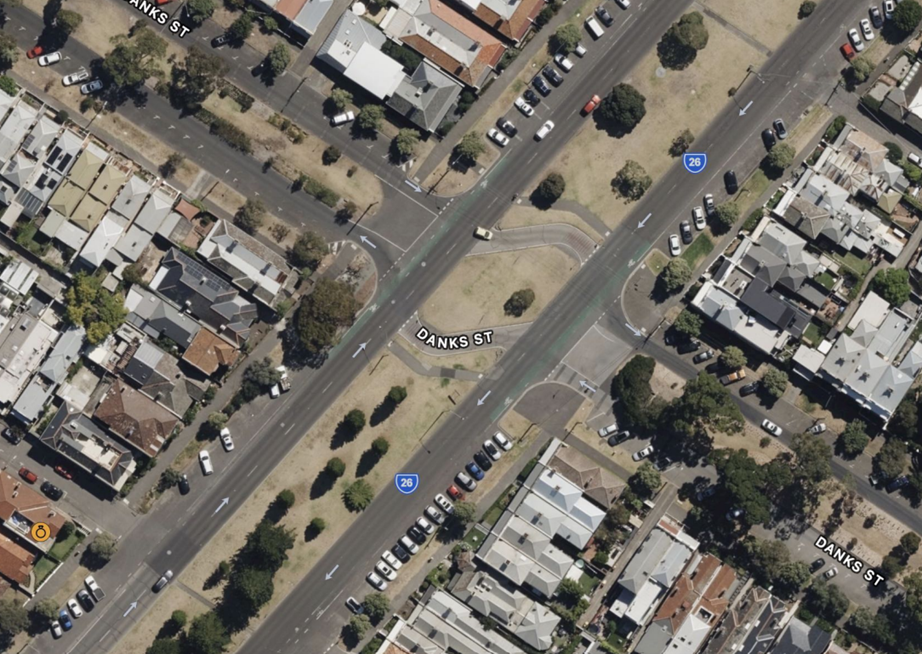
The traffic management solution at Danks Street where it crosses Kerferd Road (see Google image below) has worked well to remove the vehicle danger of the intersection. If prevention of vehicle accidents is the concern, then a similar solution can easily be implemented at the Montague-Herbert Street intersection with Kerferd Road.
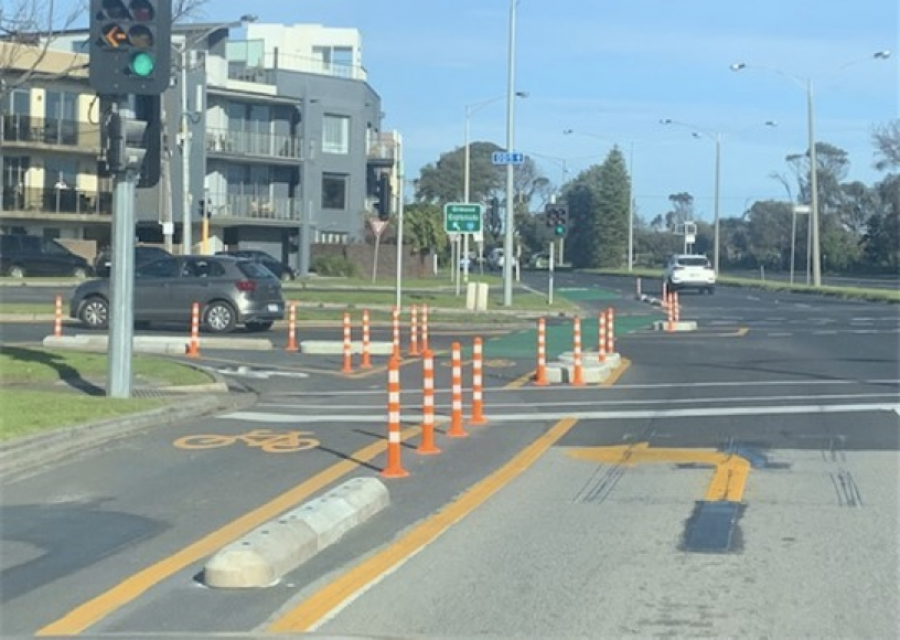
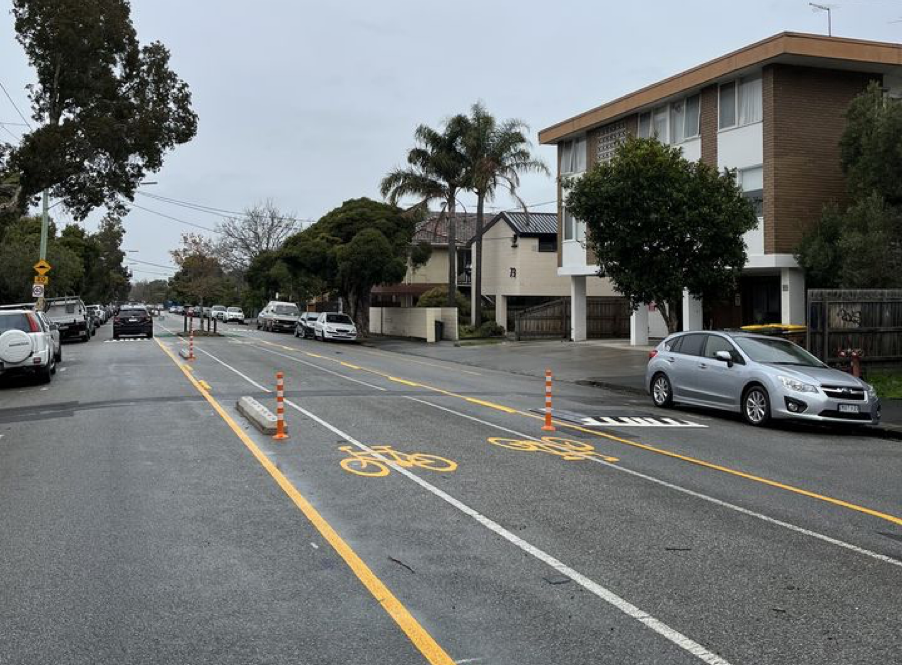
I am extremely frustrated that the Department of Transport & Planning (DTP) has not acted on a request from Port Phillip Council to remove the pop-up bike lanes almost 16 weeks since Council voted to remove the pop-up bike lanes.
I am one of a group of concerned Port Phillip residents who commissioned the report by respected traffic engineering consultants Traffix which concluded that the pop-up bike lanes infrastructure was misconceived, unnecessary and posed a danger to both cyclists and drivers alike.
I have written to Melissa Horne (MP, Department of Transport & Planning and Local Government) and Nina Taylor (MP, Albert Park) to express my extreme frustration with the total failure of the Department to act on the resolution passed by the City of Port Phillip on 8th December to remove portions of the dangerous and unnecessary blocks of concrete and other ‘pop-up bike infrastructure’ installed by DTP. Below is a copy of my email to Melissa Horne, Nina Taylor and Josh Burns (MP, Macnamara) sent on 6th March.
__________________________________________________________________________________
Dear Melissa, Nina & Josh
I have received no response at all to my email sent on 26th February, so I am writing to you once again to urge you to act to remove the pop-up bike infrastructure.
Frankly, I am astonished at the utter lack of response from any of you in circumstances where:
The Council resolution was passed 13 weeks ago
Nina Taylor made the following pre-election commitment to the community.
__________________________________________________________________________________
Here is an extract of Nina Taylor’s letter to me in November 2022.
__________________________________________________________________________________
I have read the Traffix report with interest, and I believe it provides a thoughtful and thorough assessment of this temporary infrastructure. As the Labor candidate for Albert Park, the safety of residents is of utmost importance to me.
Since the installation of the pop-up bike lanes, I have had a great many conversations with constituents who are advocating for their removal. I share the concerns of residents regarding the safety of cyclists and road users, as well as the lack of community consultation by the Council and the Department.
That’s why, on multiple occasions, I have relayed the concerns that residents have raised with me in meetings with Minister Ben Carroll, which has led to the removal of several of the most problematic bike lanes.
My commitment is absolutely clear: if I am elected at the upcoming state election, I will work with the City of Port Phillip, the Department of Transport and the Minister to remove the remaining pop-up bike lanes. I support active transport infrastructure that is properly designed and developed in consultation with the community.
More accidents have occurred directly because of the hard infrastructure the Department installed in our streets – refer to the Facebook post below from Reg Crawford as yet another example.
“We need to get rid of the concrete blocks. They are dangerous to cyclists as well. My good friend, a very good cyclist brushed the edge of one of the concrete blocks yesterday, went over the handlebars and ended up in trauma with fractures to ribs, collarbone and scapula”.
These installations have caused several accidents already so it is mystifying that you have not yet acted to remove this junk from our streets particularly since both of your ALP colleagues elected to represent our community agree with the overwhelming sentiment in the Port Phillip/Albert Park community that this experiment has failed and the concrete blocks and other items must go.
You should all be ashamed - there is no credible explanation for your collective failure in these circumstances!
Nina –the promise you made to the Port Phillip community is now ringing very hollow indeed – are you going to continue to remain silent?
Melissa & Nina: I once again urge you to take action before more accidents occur.
Please confirm when removal of the infrastructure will take place.
Three weeks have passed since I sent the email above but I have still not received any response.
HOW MANY MORE INCIDENTS WILL IT TAKE TO GET OUR 'REPRESENTATIVES’ TO ACT IN THE COMMUNITY INTEREST?
Yours sincerely
Jan Talacko


by a St Kilda Elder
Friends in Brighton are astonished when I tell them what I pay for rates in City of Port Phillip - for a small house and frontage… oh and the couple of hundred dollars extra I have to pay, so I get to park on my street and to allow my 96 year old Dad a visitor parking permit if he visits.
So imagine my surprise, and my indignation when I recently discovered that CoPP is planning to kick in financially, to assist to our wealthier Bayside neighbours to upgrade parts of Elsternwick Park; including an Urban Forest and Wetland. It is only a few years ago that I tied myself to a tree on the old Beachcomber Marine Parade site, as I saw men with chainsaws arriving to cut down a bunch of very old (probably over 100 years) Washingtonia Palms (the very tall skinny ones) which had adorned the site. I thought CoPP was the greenie Council, with respect for “significant trees”. Yet these grand old graceful palms were hacked down, all over the block to make space for the 23 apartments which now stand there. Before the police came to escort me off the site, someone showed me a piece of paper which indicated the trees "were or would become unstable". Well yes, if you dug foundations or basements under them, of course they would become unstable! God forbid the architects could consider a slightly lower density urban French approach, seen all over central Paris, where apartments are built around enclosed gardens containing… trees!
Ok that’s one gripe off my mind! But now an “Urban Forest and wetland” in Elsternwick Park? I've walked a dog all around that park. I've played golf on the course. Seemed like there were plenty of trees and ponds to make my terrible golf game even crappier. Ducks and other birds abounded. Even frogs. It was a bit rough and ready in places - but then...that’s nature!!
On 21 March 2018 CoPP met to discuss “the development of an Urban Forest and Wetland in Elsternwick Park North, subject to confirmation that the Urban Forest would reduce flooding, improve public amenity and water quality, includes water harvesting and distribution and protects and enhances biodiversity.” [Meeting minutes Port Phillip Council 16/3/22: Exec Summary para 2.1]
Wetlands make sense, but so do composting toilets and I don’t see any of them around St Kilda/Elwood/Elsternwick. Perhaps the well-paid Council workers would prefer not to have to distribute humanure. Biodiversity, stormwater harvesting, and public amenity are all fab aspirations - on my teeny block I have water tanks and possum houses and amenity galore. However, the goal of the upgrade had as its first cited aspiration “...reduce flooding…” Having experienced firsthand the 1984 Kilda/Elwood flood, when canoes were paddling down Wordsworth Street outside my house and water was tiptoeing up to my veranda, I thought the flood mitigation plan, albeit in an adjacent Council, might be worth something to St Kilda/Elwood areas.
But the first part of the Masterplan to bite the dust was - yes you guessed - the “flood retention basin” as Melbourne Water “chose to instead pursue an alternative flood mitigation option.”
The cost to Bayside (without the flood mitigation basin) is to be around the $20 million dollar mark, of which $12 million is for the wetlands construction and stormwater harvesting components. Estimated costs for transporting water to Point Ormond, MO Moran Reserve are estimated to cost CoPP ratepayers $300k-600k and if transported further to St Kilda Botanic Gardens and the Peanut Farm - $3-5million. Wait for that Ratepayers!!!
Currently the CoPP ratepayers are already contributing funds as a "co-funder” of the design stage “...in the 2022/23 financial year …approximately $320,000 is required to project manage the design and engage consultants to complete the design.” [CoPP Minutes 16/3/22 para2.7]
And of course, it won’t stop there… So put your hands up Ratepayers of CoPP - who wants to kick in for yet another eco education centre, the urban forest which might not have been necessary but for CoPP block clearing for more high-density development meaning additional rates for them. Oh and increased amenity for a park that is not even in our Local Government Area.



By Dean Hurlston, Ratepayers Victoria, Inc.
It is well established that Council CEOs move around the industry to advance their careers.
The vast majority of Large Council CEOs come from smaller Councils or roles within the local government sector. A review of CEO profiles on LinkedIn shows just how mobile Council Executive staff and CEOs are. They are always on the lookout for larger roles and larger pay packets.
Across Victoria there is an immeasurable talent pool from Private industry , but you will rarely, if ever, see any of the Private sector talent running our 79 Councils.
Local Councils do not have a definition in law that constrains them to rubbish, roads and rates which is what most people expect Councils to deliver on.
The Local Government Sector is awash with CEO’s and Executive staff that are in it for one reason and one reason only – to resume build, and they don’t want competition from the private sector.
When the Local Government Act was updated in 2020, the CEOs and their union (The MAV) took absolute exception to the Minister at the time (Adem Somyurek) inviting ratepayer organisations to make suggestions on what needed to be changed.
It was no accident, but it was a defining moment.
For me, it was the start of a study of the Local Government Sector and why CEO’s did not want the end user, consumers (residents and ratepayers) being anywhere near the legislative changes.
Many good suggestions made it into the original draft legislation, only to be removed by intense lobbying by the MAV and Council CEOs. Some of the changes sought to address the power imbalance the public has when dealing with the CEO and executive staff.
When power does not want to be accountable and is fastidious in lobbying against any resident and ratepayer protections, you know there is cartel behaviour behind it.
So what is this cartel?
Quite simply CEOs preside over budgets of hundreds of millions of dollars. They also have very high delegated spending limits (some as high as $2M). These delegations mean the CEO can spend this money without ANY accountability. Only if a spend goes over do they need Councillor permission.
There is a long established pattern in Councils (uncovered by the Victorian Auditor General VAGO, and the Ombudsman) of getting around delegated authority limits by breaking spends into smaller amounts to avoid scrutiny. This has been raised for many years by VAGO as a corruption risk, yet still nothing changes.
Further to this, CEOs use Council projects as the money makers to progress their own careers. These projects have slim, rhetoric-based business cases, if at all. They also use large swathes of ratepayers’ money or enormous amounts of borrowings. Either way, it is long known amongst the CEO group that the way to grow your career is to “BUILD STUFF”. CEOs often go to councils where there is a significant build pipeline because this is what motivates them.
It is of course these projects that build ones resume and career opportunities.
The boring stuff of council, running an efficient and lean business is absolutely not on the agenda.
Any listed public company director knows that a good CEO is able to do two things – run an efficient and cost-effective business and innovate to drive transformation that better serves its customers or stakeholders. Yet why is this the antithesis of Council CEOs?
Self Interest. If there is one thing all CEOs have learned in the political machinations of Councils, it is of their self-interest. They are not responsible to industry KPI’s, or standards and they can pretty much make anything up as they go. There are horrific stories across the industry of fraud, politicisation, and cost blows outs, but rarely if ever does a CEO get fired. If they find themselves in a position that is untenable, they are easily able to move Councils and leave behind the trail of destruction, for the ratepayers to pay for yet again.
The Council CEO industry is awash with Ego and hubris. They all regularly inform the government and ministers about their views of what needs to happen in the industry and so far we have a government hell bent on protecting the CEO culture instead of holding them accountable.
Let’s be clear here, many Council CEOs wouldn’t last a month in the private sector, accountable to a real board of directors. They don’t have the business acumen to run a lean and efficient organisation.
On the topic of building, we have seen so many communities oppose large projects and offer alternative cheaper models over the years. Every time they have been outmanoeuvred and outsmarted by CEOs and executive groups who have access to top lawyers, top experts and advisors who will do and say anything to defeat well-meaning residents and ratepayers.
This is the dilemma of Councils. A corporation, run by CEOs who do not have to answer Councillors questions, who keep councillors stage managed with only the information they want to share.
CEOs who have unfettered power. CEOs who can hide community grant recipients connected to Councillors. CEOs who can command internal reviews when things go wrong, but nothing changes. CEOs who buy luxury cars to keep mayors happy. CEOs who know that ultimately, they run this show and they call the shots. CEOs who know that building large projects keeps councillors happy too. These projects help their favourite councillors get elected and re-elected. CEOs who know that they can do things politically for Councillors that will keep them in a job. CEOs who can sit on boards and regularly be keynote speakers in businesses that profit from the sector.
CEOs who wouldn’t dare go to the public sector because that would be an impossible transition.
CEOs who know the sector doesn’t hire from outside, so they are always a protected species.
So next time you drive past a Council project worth tens of millions of ratepayer dollars, whether it be a pool, an indoor stadium, a multi-level carpark, a retail precinct, or a new Town Hall, just remember that this is the legacy of Council CEOs. Their only purpose. To build stuff for their resume and continue to grow the ever-ballooning number of staff at their beck and call.
While they are at it, they command salaries of $300,000 - 700,000 per annum. More than our highest paid state politicians, yet the CEOs are not elected and control $12 billion our money every year.
A Cartel, you bet!



In a win for residents, Department of Transport (DoT) has announced the withdrawal of proposed designs for the pop-up bike lanes on Kerferd Road following extensive community consultation and based on the feedback received. This means DoT will no longer make any changes to Kerferd Road as part of the Pop-up Bike Lanes Program.
The decision is a win for residents who actively campaigned against the proposal. Heidi Ireland, a resident on Kerferd Road, together with her neighbours, obtained signatures from the majority of residents specifically impacted by the ‘parking separated bike lanes’ and organised residents to provide feedback to DoT officers at a marquee set up on the corner of Montague Street and Kerferd Road on Saturday 2 April. Residents objected to the ‘floated parking’ design, removal of car parking in front of their properties and loss of two lanes of car traffic which would have would have diverted traffic to local streets and worsened the rat run.
Heidi said “we are absolutely in support of making Kerferd Road safer for bike riders, however not at the cost of pedestrian safety, in addition to reduced access to homes. We believe there is a practical solution here - but unfortunately so far there has only been an all or nothing approach considered. We are still concerned plans for parking separated bike lanes and removal of two lanes of traffic will be revisited when Department of Environment, Land, Water and Planning (DELWP) construct their $13 million ‘Shrine to Sea’ project”.
DELWP’s website indicates the new boulevard connecting Domain Gardens to Port Phillip Bay along Albert and Kerferd Roads, will consider ‘improving safety and experience for people walking and bike riding’ and they have foreshadowed the ‘use landscaping to define a separate bike pathway on Kerferd Road to isolate bikes from cars’ https://www.environment.vic.gov.au/shrine-to-sea
It is concerning that the Department of Transport in relation to community consultation claim “Overall support for speed limit reduction, reconfiguration of Kerferd Road to one traffic lane and safety improvements” - source. Based on feedback from residents there is no support for reconfiguration of Kerferd Road to one traffic lane.
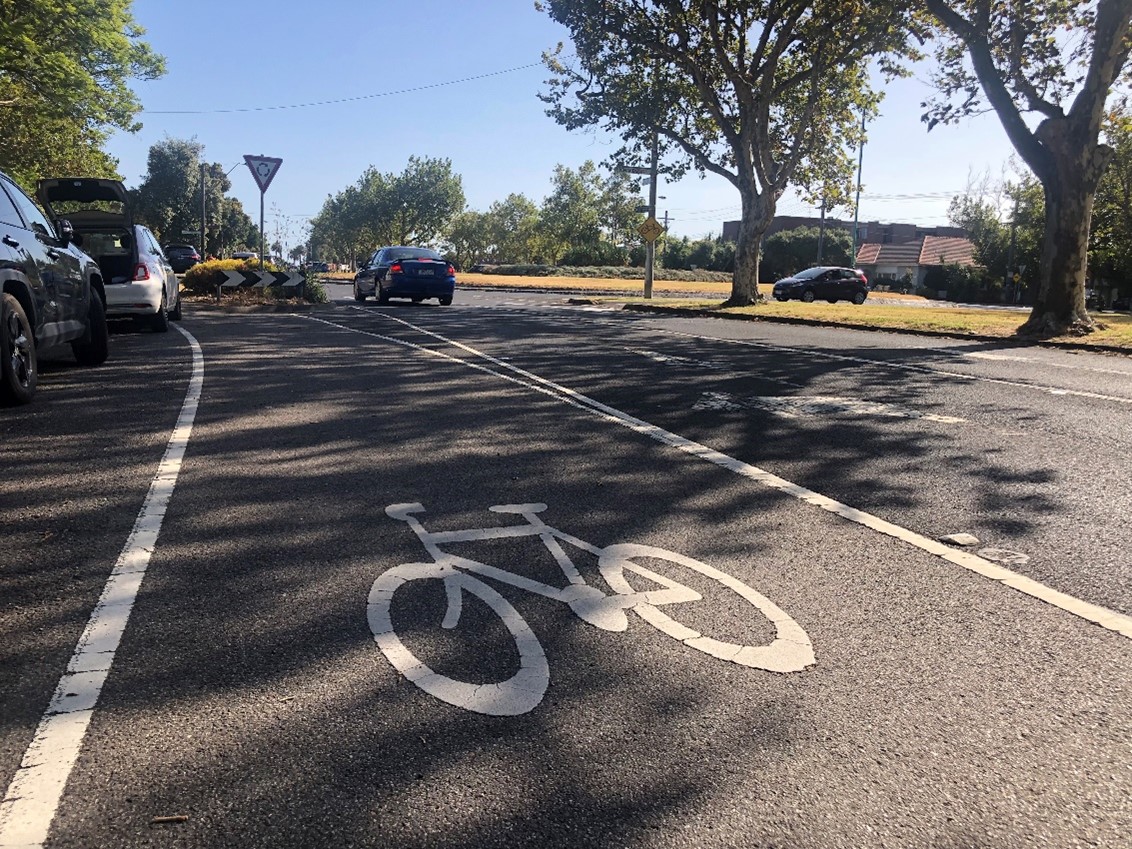
Greg, a resident who objected to the proposed pop-up bike lanes on Kerferd, objected to the plan to remove one-lane of car traffic in each direction at the Richardson Street Roundabout and on Albert Road under the light rail. Kerferd Road is a major arterial that connects Beaconsfield parade to Albert Road and Kingsway. Removing the lane under the light rail would make it impossible to get families to sport events at MSAC. Greg said that “This is a very wide road, with existing bike lanes, and would easily accommodate a better design solution that meets the need of bike riders and other road users. I would like Vic Roads to retain the two lanes of car traffic, introduce a 50 Km/h speed limit on Kerferd Road, and together with separated bike lanes that continue through the roundabout, this should be sufficient to meet the safety needs of all road users.”

Image from the ROPP election campaign in 2020.
According to a report paid for by Australian Services Union (ASU), the Victorian Government’s Fair Go rate cap has cost jobs in the local government sector. The ASU commissioned the Australia Institute’s Centre for Future Work to investigate the impact of the Victorian Government’s Fair Go rate cap which was introduced in 2016 to protect consumers from excessive increases in council rates. The cap limits increases in rates revenue to the Consumer Price Index (CPI).
The report titled “Putting a Cap on Community, The Economic and Social Consequences of Victoria’s Local Government Rate Caps Policy” concludes “The Victorian State Government’s policy to cap the rates of local government has cost the Victorian economy 7,425 direct and indirect jobs in 2021-22” The report also states, “The rate cap policy, imposed by the Victorian state government on local governments, interferes with the mission of service delivery and expanded, secure employment”. (Source: https://australiainstitute.org.au/report/putting-a-cap-on-community)
The ASU is the representative body for local government workers and is lobbying to abolish or amend the rate cap because it says their members “are increasingly overworked and underpaid in a way that is not in step with the broader public sector”.
With its tongue firmly planted in its cheek, the Ratepayer of Port Phillip (ROPP) ran an election campaign in 2020 asking, “How many council staff does it take to change a light bulb?” The campaign reported that Port Phillip rates are excessive compared to neighbouring Councils. This is because Port Phillip Council spends more than its neighbouring councils and the largest cost is employees. Benchmarked against other councils, COPP has much higher staff costs per resident. Does anyone kid themselves that Port Phillip needs 48% more staff per resident than Stonnington, 63% more than Glen Eira and 94% more than Bayside?
Therefore, it is not surprising that the study commissioned by the ASU is being used by the ASU for the benefit of their members. The study argues for the abolition of the rate cap to grow more jobs. This is offensive to those who pay rates and enjoy the protection of the rate cap. If the ASU had its way and thousands of jobs were added to Victorian Councils’ payroll, it would mean ratepayers would have to cough up hundreds of millions of dollars in additional rates annually.
Local government has been politicised by vested interested such as the ASU and political parties. ROPP was formed to elect Councillors to represent residents and businesses and not these vested interests. Since before the 2020 Council election, ROPP has set out to ensure ratepayers are armed with the facts about how their rates are spent.
Let’s bust some myths that are floating around COPP:
Myth 1: Services will be cut if Councils don’t get enough rates.
Reality: Councils needs to learn to live within their means like ordinary businesses and residents do. If times are tough, they need to evaluate choices and put some ‘pet projects’ to bed.
Myth 2: Councils need more staff as they deliver services like roads, libraries, planning etc
Reality: Many Council employees are employed delivering services to residents. But a large number are employed to write reports, commission research or promote the Council.
Myth 3: Council costs are increasing more than the rates cap, and they need a rise to keep up with cost increases
Reality: Governments, businesses and households are facing a reality of higher cost of living pressures after a long period of a benign inflation environment. Other levels of Government, not to mention businesses and taxpayers, have had to adjust to these higher cost of living pressures and so should the City of Port Phillip.
Myth 4: additional jobs can be created at no cost
Reality: They would require a huge additional tax burden in higher rates taken out of the pockets of local residents and businesses.
The ASU find the reality of budgeting and sound financial management to be an inconvenient truth. In response to our election campaign, the President of the ACTU, Michelle O’Neil, campaigned against ROPP endorsed candidates in a social media video during the 2020 Port Phillip Council elections. More recently the ASU is paying for research from the Australia Institute to confirms its desired outcome: more jobs for their members.
What do you think? Do you think residents can afford an uncapped rates system that would allow Councils to get away with amassing an even larger number of staff? Let us know your views at ppm.editor@gmail.com .