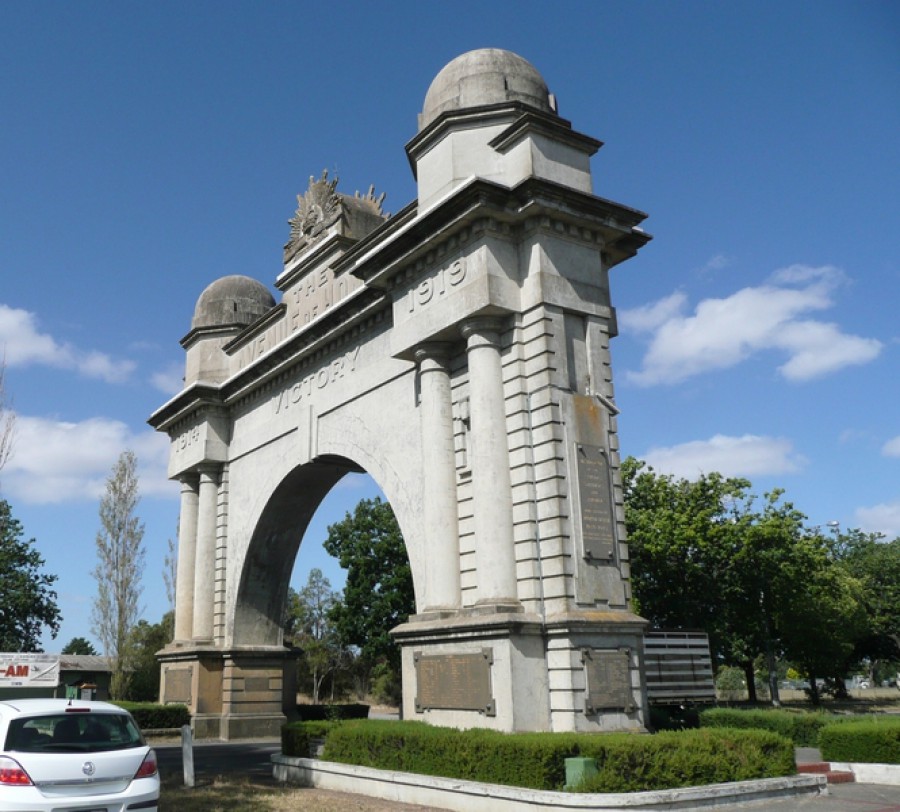
The Avenue of Honour (1917 - 1919) and Arch of Victory (1920) were erected as memorials to the people of the Ballarat and the surrounding district who enlisted in World War I. The Avenue of Honour consists of 3,771 trees planted at regular intervals of approximately 12 metres along 22km of the Ballarat-Burrumbeet Road. The Arch of Victory marks the beginning of the Avenue of Honour at its eastern end. The Avenue of Honour, with the Arch of Victory, was officially opened by the Prince of Wales on 3rd June 1920.
The planting of the Avenue commenced in June 1917 on the suggestion of Mrs W. D. Thompson, a director of clothing firm E. Lucas & Co, Ballarat, that an avenue of trees be planted in honour of the men and women of the district who had enlisted for service. The planting of one tree for each enlisted person began in June 1917 with funds of £2,000 raised by the 500 women employed in the factory, known as the 'Lucas girls'.The planting, carried out in eight phases over the next two years until its completion in June 1919. The planting, done by staff of the Lucas factory with the support of local farmers included 23 species of trees, mostly exotic deciduous species planted in single lines along either side of the road at regular spacings of 10 - 12 metres.Each species was usually planted in blocks of about 25 trees on either side of the road. The trees were numbered and allocated to individuals as close as possible to their order of enlistment, beginning at the Ballarat end. Plaques were originally attached to each timber tree guards giving the individual's name, the unit in which he or she enlisted and their number in the avenue. In 1934 these were replaced by permanent bronze plaques at the base of each tree, of which more than 80% are still in place.
Following cessation of hostilities in 1919 and completion of the avenue plantings, the 'Lucas Girls' led by Mrs W. D. Thompson began planning and fund raising of £2600 for a commemorative arch to provide an entrance to the Avenue of Honour. The Arch of Victory, designed by H.H. Smith, Head of the Art School at the School of Mines Ballarat, was a grand cement rendered masonry structure of a single central arch flanked by wide piers 20metres in width, spanning the roadway, and 18metres high. The arch, erected in 1920, is crowned by the 'Rising Sun' symbol of the Australian Commonwealth Military Forces beneath which the words Avenue of Honour and Victory are written prominently across the arch. In addition to the initial costs, for the Avenue of Honour and the Arch of Victory, a further £400 was donated by the public to a Maintenance Fund, with a returned soldier employed to attend to the trees.
During the First World War, the Avenue of Honour played a commemorative role and provided a stimulus for more people to enlist. Unlike other forms of memorials, avenues of honour and in particular the Ballarat Avenue required a high level of community participation in their creation which took place over a substantial period of time. Subsequently the Arch of Victory and Avenue of Honour became emblems of civic commitment to the war effort.
There have been a number of changes to the Avenue of Honour.Several of the original 23 species did not flourish and were replaced with species of Elms and Poplars which are the dominant genera of trees in the Avenue. In 1997, the Avenue consisted of 3,332 trees of forty different species and cultivars. Approximately half were found to be of fair to poor health and a management strategy developed, including the replanting of some trees.
In 1936 a memorial Cairn and Cross of Remembrance were erected at the Learmonth end of the Avenue where a tribute tree was also planted in 1959 in memory of Mrs W. D. Thompson. In 1938 a Memorial Rotunda was constructed 180m west of the Arch of Victory originally containing a 'Book of Remembrance' with the name of every person for whom a tree was planted, information now contained in a Roll of Honour on engr
...lebih banyak