


Immagina una nazione
Immagina una nazione in cui una singola app per telefoni cellulari è disponibile gratuitamente per descrivere cosa succede in tutta la nazione, nonché per descrivere la sua eredità e cultura in più lingue. InfoPond raggiunge questo alto traguardo - ed è vivo e gratuito per il pubblico in Australia - oggi.
...more

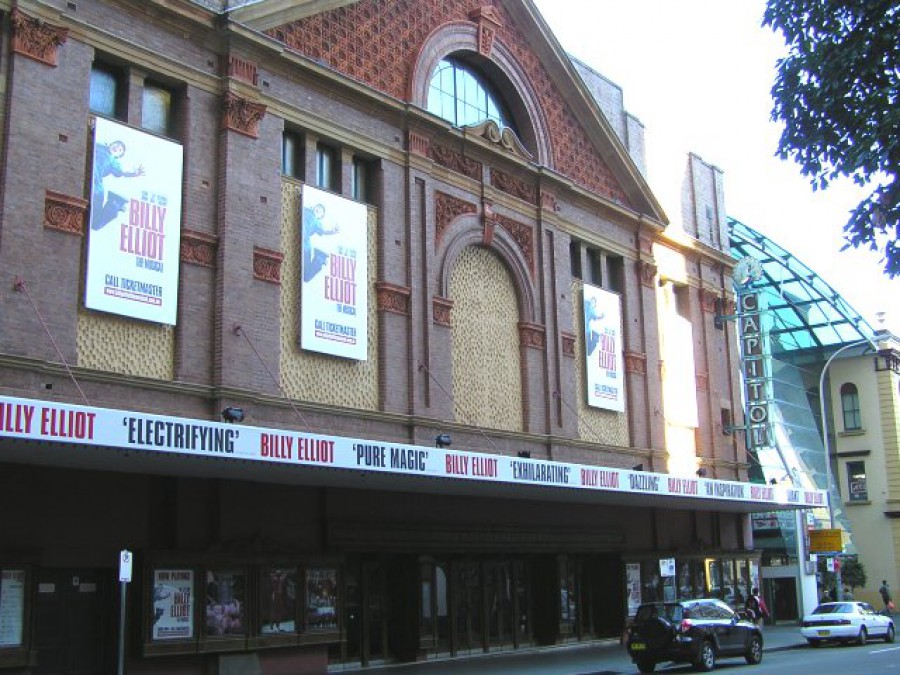
Designed by Henry White and John Eberson and constructed and varied over 1893 to 1928.

Timeline:

  • 1893 - Belmore markets completed.
  • 1913-1917 - redevelopment and conversion to Hipporome.
  • 1927-1928 - conversion to Capitol theatre.
  • 1933 - 1972 - interiors gradually stripped.
  • 1972 - atmospheric and ornamental fabric removed and altered.
  • 1990s - restored and reconstructed.

During the 1880s facilities for the bulk sale of fruit and vegetables came under increasing pressure. In March 1891, Sydney Council appointed a committee to recommend a new site for a major covered market. They suggested the adjacent space of the Haymarket and this proposal was adopted in the following July. The principal contractor for the building was Alexander Allen of Summer Hill and his tender of 24,902 pounds was approved in November 1891. The markets opened in July 1893.

The New Belmore Markets as it was called was designed by George McRae. The facade presented thirty-six arched bays to the streets: eleven to Campbell and Hay and seven to Parker and Pitt. The New Belmore Markets was not an economic success and led Council to seek alternative uses for the building. In 1912 the New Belmore Market was leased for ten weeks to Wirth Bros for the purpose of a circus and hippodrome. Council decided to recycle the fabric of the New Belmore Market to create a theatrical circus venue.

In September 1912, the Council accepted Wirth's tender for a twenty-one year lease of the proposed Hippodrome. The conversion was under the control of Robert Hargreave Broderick. The facade was dismantled and re-erected above a new ground storey which was in turn mounted on the old footings. The redevelopment was split into two major contracts: the eastern half now known as the Manning Building was awarded to J. M. & A. Pringle in May 1913 and the Hippodrome theatre to the west to William Maston and Thomas Yates in December the same year.

The Hippodrome finally opened in April 1916. Despite the Hippodrome's versatility, it was not a financial success and by 1926 Wirth's had decided to seek the remodelling of the buildings as a picture palace. Plans for the work were completed by Henry White in February 1927 for 'Capitol Theatre Sydney Limited' and the same month Wirths wrote to the Sydney City Council requesting a 'remodelling' of the building for its proposed new function. Henry White was a very experienced theatre designer and in 1927 visited America with Stuart Doyle, the managing director of Union Theatres Ltd., to review the latest developments in theatre design. Whilst in the United State, architect John Eberson was engaged to provide White with designs for the conversion of the Hippodrome. The plans for an atmospheric auditorium were very much like Eberson's Riviera at Omaha, Nebraska. The conversion involved remodelling the interior and raising the roof trusses to make room for the atmospheric ceiling and extended slope of the new gallery.

In May 1927, the Sydney City Council approved Wirth's proposed alterations. The Capitol opened on the 7th April 1928. In 1929 the theatre was fitted to screen talkies but by 1932 Greater Union was in financial difficulties with the Depression. In November 1932 the Capitol closed its doors. It re-opened in April 1933 screening second-rate movies. Maintenance economies gradually put machinery and lighting out of action and in 1945 all 'unwanted' decoration including banners, tapestries and artificial foliage was stripped from the interiors.

In 1972 the theatre lease was removed from Greater Union Theatres and awarded to Harry M. Miller for the production of Jesus Christ Superstar. At that time the atmospheric and ornamental fabric was removed. During the 1990's the lease was transferred to Ipoh Garden Developments Pty Ltd. At this time the Capitol Theatre underwent a detailed restoration and reconstruction to recover the original 1928 experience. It has now been returned to its original grandeur.

...more
The Douglas A-1 Skyraider was an American, piston-powered, propeller-driven single-seat attack aircraft. The Skyraider in Vietnam pioneered the concept of tough, survivable aircraft with long loiter times and large ordnance loads of bombs, napalm and rockets.

The USAF lost 201 Skyraiders to all causes in Vietnam, while the Navy lost 65 to all causes.

The A-1 Skyraider was the close air support workhorse of the South Vietnamese Air Force (V. N. A. F.) for much of the Vietnam War from September 1960 until the end of the war in 1975.

As the U.S. ended its direct involvement in the war, it transferred the remainder of its Skyraiders to the South Vietnamese, and by 1973, all remaining Skyraiders in U.S. inventories had been turned over to the V. N. A. F. Unlike their American counterparts, whose combat tours were generally limited to 12 months, individual South Vietnamese Skyraider pilots ran up many thousands of combat hours in the A-1, and many senior V. N. A. F. pilots were extremely skilled in the operation of the aircraft.
...more
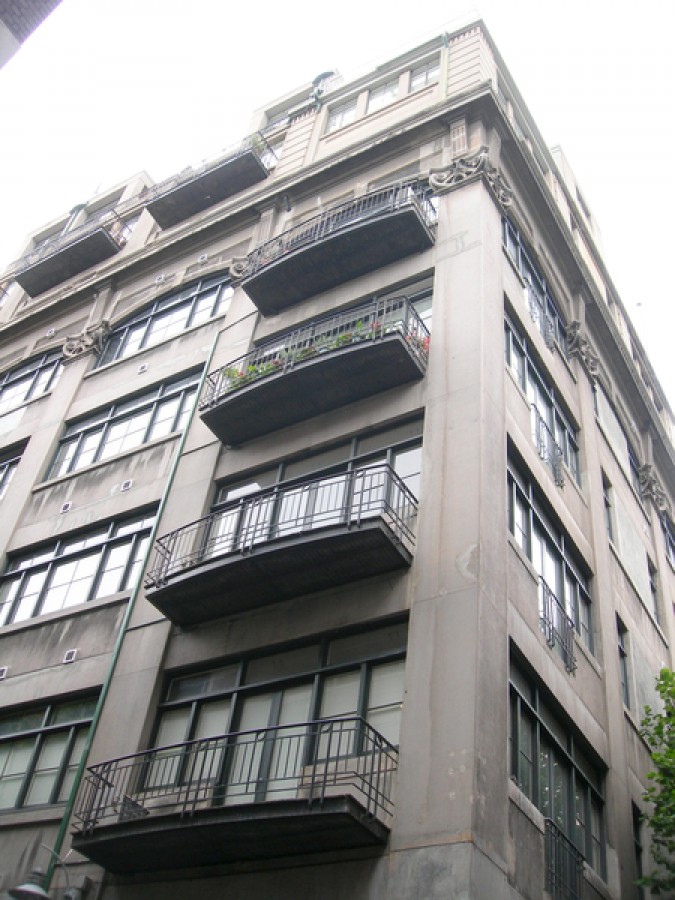
Dovers Building, was constructed in 1909 to 1910 to the design of the engineer/architect Hugh Ralston Crawford. The building was erected as a warehouse and factory for the firm Sniders and Abrahams, Manufacturing Tobacconists. Dovers building is an indicator of the size and importance of the tobacco industry in Melbourne at the turn of the nineteenth century and a reminder of the industrial character of this part of Melbourne until the latter part of the 20th century.

The northern part of Melbourne, around Little Lonsdale and La Trobe Streets, where this building is located, was home to a number of industrial establishments, before changing transport requirements, rising land prices and the outward spread of the metropolis pushed them to more practical locations from the nineteen sixties onward.

Originally a five storey structure, the building is of technical significance as the first Australian building to employ the Turner Mushroom System of flat-slabs. This system was first described in the United States of America. Between 1906 and 1909, at least eighteen other buildings were built in the United States of America using the Turner Mushroom System of flat-slabs. This system was so called due to the peculiar formation of rods around the column head and the rapidity with which they could be erected. The Turner system, as used by Crawford at the Dovers Building, employed thin concrete floor slabs, which were reinforced in four directions and supported by octagonal columns. The Dovers building remains as one of the still surviving examples in the world using the innovative Turner mushroom system of reinforced concrete.
...more
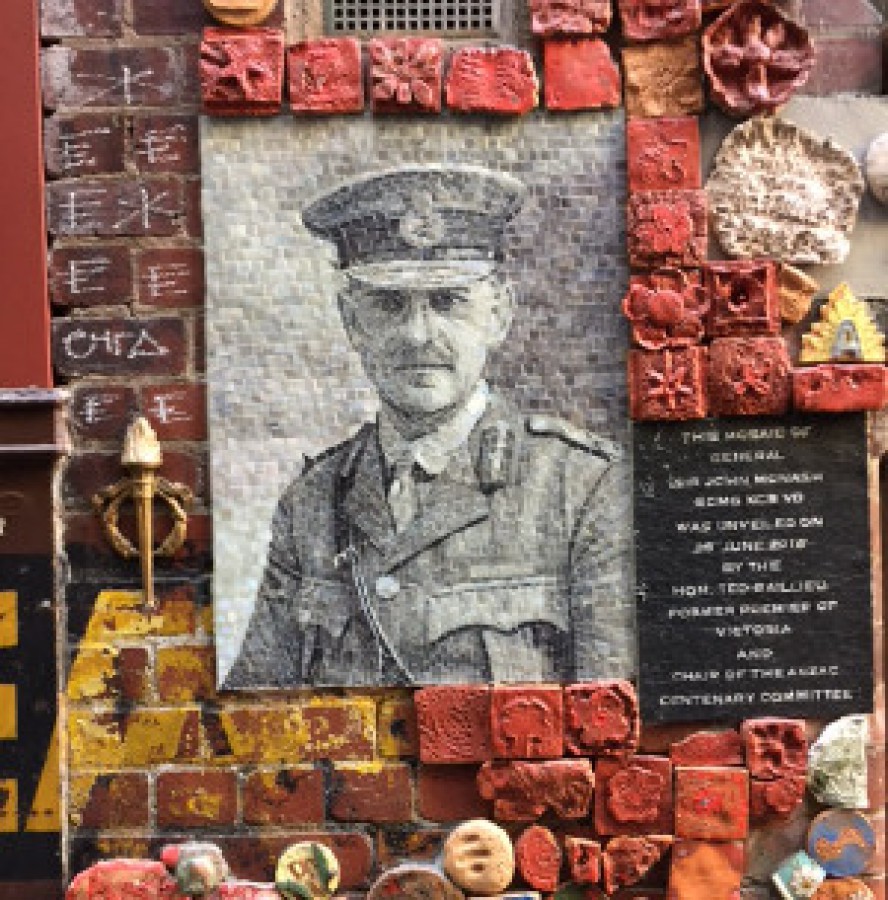
The image is that of a mosaic. This is one of a variety of mosaics and just one of many artworks located in this area.
...more
Warragul Drill Hall was built from 1912 to 1913. It was the first of about forty timber and iron drill halls built in Victoria between 1912 and 1916 and was the prototype for all of this type built in Australia following the introduction of compulsory universal military training in 1911.

Commonwealth architect John Smith Murdoch was probably responsible for the generic design, apparently developed from Queensland models, in response to the Minister for Defence's stipulation that "the cost of drill halls was to be put down to bedrock". Although the drawings for the Warragul Drill Hall were signed by Thomas Hill, Works Director, and Horace J. Mackennal, draftsman of the Victorian Public Works Branch of the Commonwealth Department of Home Affairs, Murdoch had ultimate design responsibility.

Warragul Shire Council donated a block of land adjoining the showground and recreation reserve and on 13 August 1913 the Warragul Drill Hall was opened, the first of its type in Australia. Built originally for the Warragul, Drouin and Trafalgar area to house the 46th Infantry, 13th Light Horse and 45th Cadets, the drill hall has been home to a number of units. It also served as a recruiting centre during both world wars, a prisoner of war control centre from 1944 to 1946, a sports facility, and is currently used for gymnastics classes.
...more
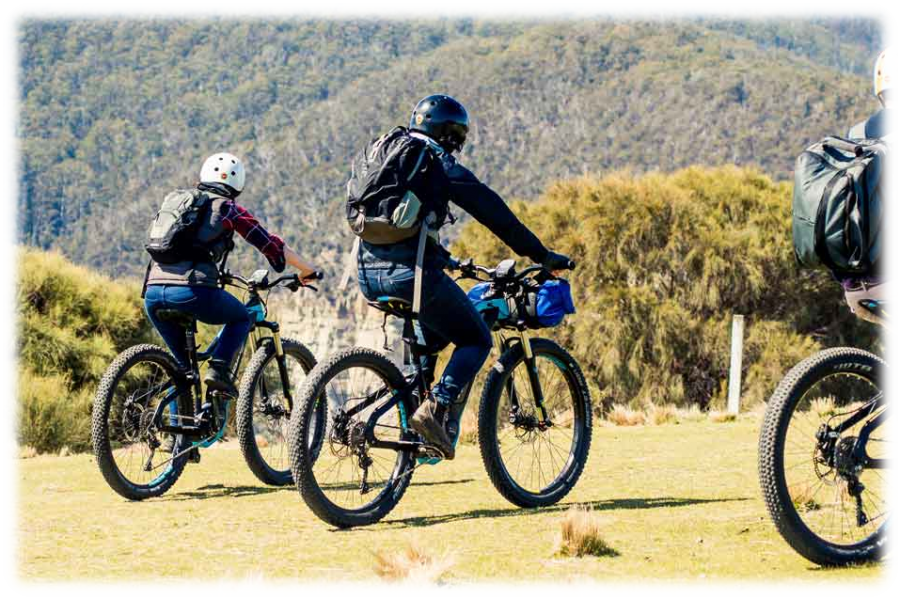
The Bangor Adventure uses state of the art pedal assisted Electric mountain bikes to explore Bangor, an extraordinary private Tasmanian coastal property. Natural trails through Blue gum and She oak forests allow us to reach the spectacular Cape Frederick Henderick.

The Maria Island eBike Adventure shares the stories of contact between Tasmanian Aboriginal people and the first European explorers. Abel Tasman named the island Maria in 1642 after Maria van Dieman, wife of Anthony van Diemen, Governor-General of the Dutch East Indies in Batavia. Your story-based adventure connects you to the island’s convict inhabitants and their struggles to escape, along with the pioneering spirit of 19th century Italian entrepreneur, viticulturist and industrialist Diago Bernacchi and the visionary wildlife conservationists responsible for the protection of Maria as a National Park.

Email: benrea@tasmanianadventures.com.au
...more
Plague of colourful scooters makes sudden appearance, then dwindles

Ron's Rant

The plague of colourful scooters that has made a sudden appearance in our suburbs is dwindling with less and less foreshore riding as the 'new toy' uniqueness wears off. What hasn’t been noticed by many is the occasional scooter that has found its watery grave in our bay and waterways. I don't have an opinion either way on the virtues of scooters other than that there need to be rules as to their proper usage. The glaring thing that does stick out in my mind is the fact that our public servants, the ones that are charged with implementing these activities, give no thought as to educating the general public as to their safe and proper use. 

The right to drive a motorised vehicle such as a car requires many hours of supervised instruction, learning of road rules, culminating with a driving test to ensure that new drivers on our roads are fully aware of the rules to keep themselves and other safe. 

Unfortunately, this is not the case for other users of our roads such as bike riders and now motorised bicycles and scooters. It seems ludicrous that these riders can just hit our roads with no instruction, training or knowledge of the road rules. Top that off with the crazy and thoughtless ingress of council funded bike lanes in our suburbs that are squeezing out already congested car lanes and putting both bike/scooter riders at risk. Our Public Servants have given no thought to the safety aspects of putting slow moving cyclists, bikes/scooters, that have little knowledge or rules, on the same roads as cars both moving and parked. The onus of safety is being unfairly put on the licensed drivers rather than the unlicensed riders. 

Painting a couple of white lines on the road and then declaring that this is now a sacrosanct push bike pathway has been a stupid and dangerous act perpetrated by all our public services in the name of stemming the tide of global warming. Surely the safety of our citizens should be paramount and not be warped by idealistic political stupidity that puts people at risk. Our roads were designed for motorised vehicles such as cars and trucks and motorcycles. They are all registered and insured and driven by educated, licensed drivers and riders. To mix the educated and slow moving uneducated (or at least untested) on the same roads beggars belief. They need to be kept apart.

Our unthinking Public Servants should be ashamed and taken to task for their stupidity in letting our roads system deteriorate to what they have become, placing citizens in harm’s way. This fast-moving world is changing, and electric vehicles will soon be taking over our roadways. Roads that were designed to move, not block traffic. Councils and State government need to stop scooting around the subject and create a decent plan for allowing our community to commute safely, whether that be by car, bike, scooter or foot.

...more
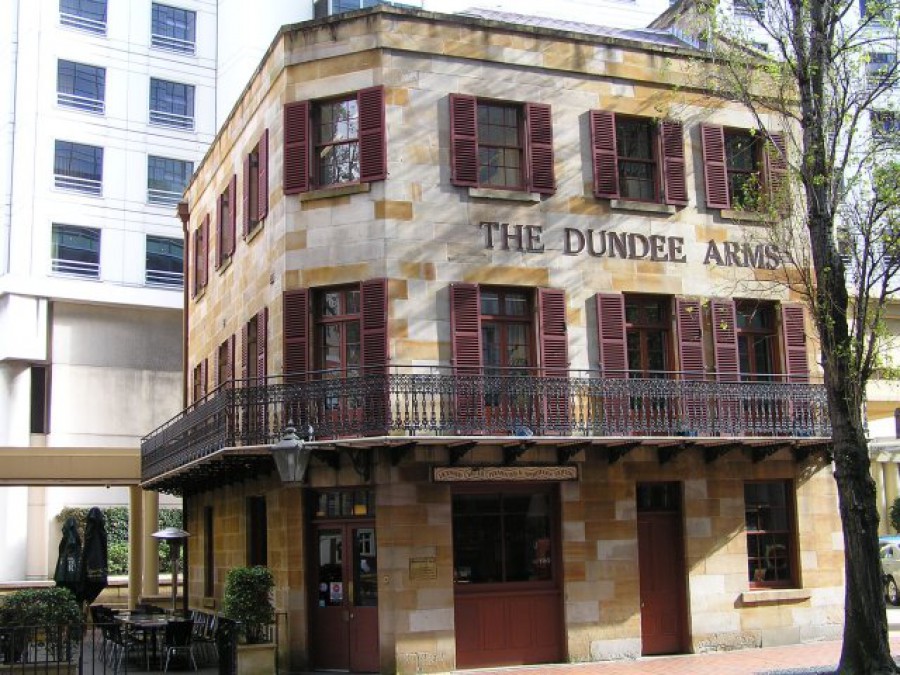
The Dundee Arms Hotel was constructed pre 1860 and is one of the oldest surviving pubs in the area. It is a feature of the development of Darling Harbour as an overwhelmingly industrial and maritime suburb, the hotel serviced the working class people employed nearby and sailors from the ships docked in the harbour. Throughout the 1870s and until 1888 it was managed by Thomas Ricketts, the hotel's longest serving publican. Pubs like the Dundee Arms were a focus for the local and visiting populations' social life. The Hotel has been in continuous operation and is now incorporated into a larger hotel, and still functioning as a bar.
...more
Last Week
Following is a quote from Alick Jackomos, Remembering Aboriginal Fitzroy community.
Were on the corner of Gertrude Street and Nicholson Street and were just outside the old tram shed. Opposite theres a Moreton Bay Fig tree. Can you see it there? That big tree? In fact theres two and thats where the Aboriginal community, both before the war and when the war was on, would come and meet. As I said before, there were no organisations and there was no Advancement League. You couldnt fit into anyones house because every family only had a little room in the house. It could be three or four families in one house. So on Saturday and Sunday, and during the week, but mostly weekends, everybody would come here and sit around these Moreton Bay Fig Trees. That was our meeting place in the late thirties and forties and maybe early fifties. End quote.

Before the establishment of organisations like the Aborigines Advancement League, the main meeting and gathering places for the local Aboriginal community in Fitzroy and inner Melbourne were the parks around Fitzroy and Carlton, in particular the Carlton Gardens.

The Moreton Bay Fig tree in the South Garden, near the intersection of Nicholson and Gertrude Streets, was one such meeting and gathering place before and during the Second World War. The Moreton Bay Fig tree and surrounds has been the source of creative inspiration, featuring in the opening scenes of The Dirty Mile, a play performed by the Ilbigerri Street Theatre Company in two thousand and six.

The gardens have a continued use as a meeting and gathering place from the nineteen hundreds to the present, as well as being an important place of gathering and meeting for local Aboriginal people from the nineteen hundreds to around nineteen sixty eight. This aspect of the gardens is also associated with Pastor Doug Nicholls, who used to preach there.
...more
Despite a petition with over 1,300 signatures council vote to go ahead

Image by Sean Cummins - see full screen

A message from the School Council Presidents - Hannah Lawson & Elisa Webb

Dear Parents/Carers,

On Wednesday night, despite a petition with over 1,300 signatures and hundreds of emails objecting, the City of Port Phillip Council voted to go ahead with their plan to place a public toilet near the entrance of our school.  

As a School Council we are very disappointed with this outcome and with the conduct of some Councillors in the meeting (particularly Cr Peter Martin, who said that SKiPPS parents need to educate their children more about safety).  

We are not opposed to public toilets, but the location needs to be well considered and we believe that safety standards and cleaning regimes need to be above what currently exists elsewhere in the CoPP.  

To summarise the vote: 

  • Cr Bond, Cr Pearl, Cr Copsey and Cr Martin voted to go ahead with the project
  • Cr Crawford abstained from voting 
  • Cr Consulo, Cr Clark and Cr Sirakoff voted against placing the toilets in the proposed location and to stop the project.

You can Listen to the Councillors discuss the proposal at the meeting on 15 June from the 1 hour 48-minute mark in the webcast https://www.facebook.com/cityofportphillip/videos/836525410663145/ 

We encourage any school families or community members who wish to show their continued opposition to the construction of the toilets at the site to write to the COPP Mayor, Cr Pearl, and the CEO, Peter Smith.

Marcus.Pearl@portphillip.vic.gov.au 

Peter.Smith@portphillip.vic.gov.au 

It is also time to escalate the issue to elected officials at the State level, and we encourage you to contact the Education Minister, the Premier and our Local Member, Martin Foley.

james.merlino@parliament.vic.gov.au 

daniel.andrews@parliament.vic.gov.au 

martin.foley@parliament.vic.gov.au 

The land in question is owned by Parks Victoria, so you can also write to the Parks Victoria CEO, Matthew Jackson, and the Chair, Hon. John Pandazopoulos.

ceo@parks.vic.gov.au 

John.pandazopoulos@parliament.vic.gov.au 

If you have any other suggestions or contacts, please get in touch with School Council via Michelle at

michelle.bove@education.vic.gov.au 

...more
There are good reasons for not implementing this and other road closures

By a concerned Mills Street Resident

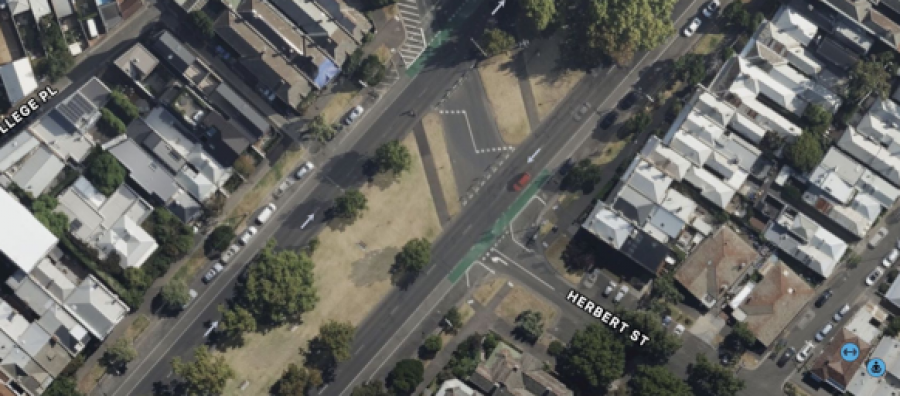
Image attribution: Google Image of Herbert-Montague Street and Kerferd Road intersection

There is increasing concern regarding the proposed Shrine-to-Sea Avenue proposed by the Victorian Government in partnership with the City of Port Phillip. Residents are concerned the project may not only divide Port Phillip but also divide the Albert Park locality. The path to Beaconsfield Parade from Kingsway along Albert Street and Kerferd Road is already clearly delineated.  Source

Many residents have voiced their concern that a dedicated path with intersecting side roads blocked off will seriously and permanently create a barrier that will have an effect similar to that which occurred when the enforced Kingsway was forged through the middle of South Melbourne – creating a freeway dividing the then city into two distinct areas with little communication between.

Residents are concerned that the closure at Herbert-Montague Street and Kerferd Road, Albert Park may be the beginning of a series of Council planned closures to implement this divisive community policy. 

The Herbert and Montague Streets closure now appears to be permanent following extensive delays of the trial that started in February 2021, with the traffic data collection. The Council website states  ‘Due to Covid-19 restrictions, we have been unable to record the final traffic data counts and will conduct these as soon as restrictions ease. Until this time the trial will remain in place’. Source

There are good reasons for not implementing this and other road closures:

1. An inconvenient barrier to the Albert Park shopping centre from the east of Kerferd Road and to Middle Park from the Albert Park side.

2. All street closures have negative impact on other surrounding streets by re-directing and increasing traffic in an abnormal pattern. Traffic will be increased on: 

  • a. Canterbury Road
  • b. Hambleton Street
  • c. Richardson Street
  • d. Merton Street
  • e. O’Grady Street
  • f. Little O’Grady Street
  • g. Finlay Street

3. Inhibits community interaction for an ageing population

4. It is not any safer for pedestrians or cyclists

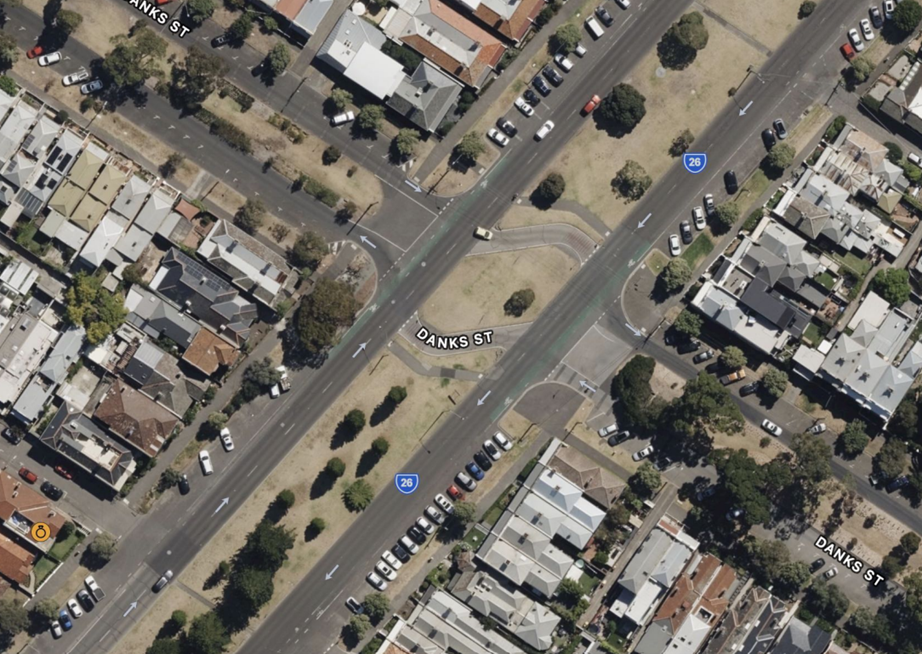
The traffic management solution at Danks Street where it crosses Kerferd Road (see Google image below) has worked well to remove the vehicle danger of the intersection. If prevention of vehicle accidents is the concern, then a similar solution can easily be implemented at the Montague-Herbert Street intersection with Kerferd Road.


...more
The 1.3 metre high bee hive weighed 25 kg

Hester Reserve was abuzz when our contractors, working with Australian Bee Supplies (ABS), carefully removed the hive and placed the bees in a temporary new home.

“Many local residents stopped and congratulated us on the work to relocate the colony, rather than euthanising the bees,” ABS chief apiarist Andrew Stanish said.

The 1.3 metre high hive, weighing 25 kg, was revealed in a hollow of the Peppercorn tree after a tree limb broke off.

The delicate removal operation included vacuum extracting the bees from the tree and housing them until a brood comb (the beeswax cell structure where the queen lays her eggs) had been re-established in a temporary hive.

It took about 10 hours for the hive to be removed and the bees settled in their temporary home. They are now in their second and final stage of quarantine to ensure the queen is laying and the colony is free of disease before being moved to a permanent home.

There are three castes of honey bees: Queen bees (egg producers), worker bees (infertile females),and drones (males whose purpose is to find and mate with a Queen bee). They perform many different jobs including nectar and pollen collecting, cleaning cells after babies are born, attending to the Queen and even removing the dead (mortician bees).

Andrew said the colony is living the sweet life. “They are docile and happy little girls. They are bringing in nectar and pollen, suggesting babies are being made.”

“Most of them are girls. The drones are boys, they essentially eat, party and mate with the queen,” Andrew said. “Bees are just brilliant and have such fascinating behaviour.”

In a similar success story, two honey bee hives are thriving after being relocated to the St Kilda Botanical Gardens in 2020 after a Newton Court Reserve tree needed to be replaced.

See source statement by council here.

...more
Promotion
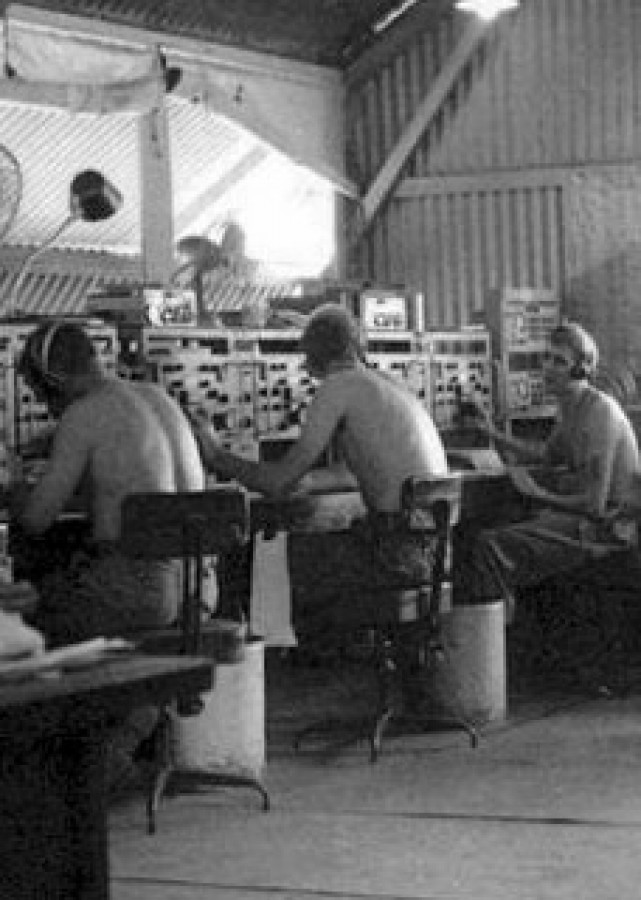
The 547 Signal Troop was deployed to Vietnam in March 1966 and returned in December 1971. Its main task was to identify and locate enemy units by intercepting radio communications. The enemy would send messages in quick bursts of Morse code.

The signalers worked at the Australian task-force base at Nui Dat, and in the air in light planes packed with sensitive monitoring equipment. Over the period of the Vietnam War 200 to 300 men went through the unit.

The troop also used light planes such as the Cessna 180A in covert missions to intercept radio signals. Two missions were flown every day at low altitude in a straight line which of course made those aircraft very attractive targets. Using equipment produced by the Weapons Research Establishment in Adelaide, they were able to locate enemy radio stations.

The North Vietnamese were aware that the Americans were intercepting them because the American technique was to fly the aircraft directly at the enemy radio station. But nobody assumed that Australians would have such proficient operators and the Australian radio direction finding technique was "fly past". That is, the aircraft did not point at the enemy radio station. There was so much aircraft activity in Vietnam that one more airplane flying passed that it didn't draw the attention of enemy radio operators.
...more
An opportunity to share your ambitious inspiration

Live music and Port Phillip just go together, and with so much talent and enthusiasm in our City for live music, we wanted to share Always Live's expression of interest for a huge Victoria-wide celebration of contemporary live music. Submissions are still open until 11.59 pm, Sunday 27 February.

Through this open call process, Always Live will engage with a range of project partners and hear about your ground-breaking, life-changing, live contemporary music event, one-off show or experience that could appear in the Always Live program.

Always Live is taking place Victoria-wide. The focus is equally on metro, suburban, outer suburban and regional areas across the state. Always Live aims to encourage visitation to the city from the regions, and to the regions from the city, as well as to attract interstate and international audiences. Whilst Always Live is not commissioning shows or offering grants, there are a range of different ways to collaborate.Your show could be included in the program to leverage marketing and promotion. There may also be financial or other resource support made available. 

Whether its atmospheric or euphoric, genre-busting or sonic shapeshifting, bright and bold, different and unexpected, impressive or unprecedented, newer than the new normal, experimental, playful or relatable, universal or personal, trending or traditional, this is an opportunity to share your ambitious inspiration.

Concepts from Victorian applicants and / or featuring Victorians will be prioritised but non-Victorians and concepts featuring non-Victorian artists are still eligible and encouraged to apply.

Expression of Interest closing date

Expression of Interest submissions close at 11.59pm (AEST) on Sunday February 27, 2022.

Submit and find out more: Get involved | ALWAYS LIVE

...more
CEOs are not elected and control $12 billion our money every year.

By Dean Hurlston, Ratepayers Victoria, Inc. 

It is well established that Council CEOs move around the industry to advance their careers.

The vast majority of Large Council CEOs come from smaller Councils or roles within the local government sector. A review of CEO profiles on LinkedIn shows just how mobile Council Executive staff and CEOs are. They are always on the lookout for larger roles and larger pay packets.

Across Victoria there is an immeasurable talent pool from Private industry , but you will rarely, if ever, see any of the Private sector talent running our 79 Councils.

Local Councils do not have a definition in law that constrains them to rubbish, roads and rates which is what most people expect Councils to deliver on.

The Local Government Sector is awash with CEO’s and Executive staff that are in it for one reason and one reason only – to resume build, and they don’t want competition from the private sector.

When the Local Government Act was updated in 2020, the CEOs and their union (The MAV) took absolute exception to the Minister at the time (Adem Somyurek) inviting ratepayer organisations to make suggestions on what needed to be changed. 

It was no accident, but it was a defining moment.

For me, it was the start of a study of the Local Government Sector and why CEO’s did not want the end user, consumers (residents and ratepayers) being anywhere near the legislative changes.

Many good suggestions made it into the original draft legislation, only to be removed by intense lobbying by the MAV and Council CEOs. Some of the changes sought to address the power imbalance the public has when dealing with the CEO and executive staff.

When power does not want to be accountable and is fastidious in lobbying against any resident and ratepayer protections, you know there is cartel behaviour behind it.

So what is this cartel?

Quite simply CEOs preside over budgets of hundreds of millions of dollars. They also have very high delegated spending limits (some as high as $2M). These delegations mean the CEO can spend this money without ANY accountability. Only if a spend goes over do they need Councillor permission.

There is a long established pattern in Councils (uncovered by the Victorian Auditor General VAGO, and the Ombudsman) of getting around delegated authority limits by breaking spends into smaller amounts to avoid scrutiny. This has been raised for many years by VAGO as a corruption risk, yet still nothing changes.

Further to this, CEOs use Council projects as the money makers to progress their own careers. These projects have slim, rhetoric-based business cases, if at all. They also use large swathes of ratepayers’ money or enormous amounts of borrowings. Either way, it is long known amongst the CEO group that the way to grow your career is to “BUILD STUFF”. CEOs often go to councils where there is a significant build pipeline because this is what motivates them. 

It is of course these projects that build ones resume and career opportunities. 

The boring stuff of council, running an efficient and lean business is absolutely not on the agenda.

Any listed public company director knows that a good CEO is able to do two things – run an efficient and cost-effective business and innovate to drive transformation that better serves its customers or stakeholders. Yet why is this the antithesis of Council CEOs?

Self Interest. If there is one thing all CEOs have learned in the political machinations of Councils, it is of their self-interest. They are not responsible to industry KPI’s, or standards and they can pretty much make anything up as they go. There are horrific stories across the industry of fraud, politicisation, and cost blows outs, but rarely if ever does a CEO get fired. If they find themselves in a position that is untenable, they are easily able to move Councils and leave behind the trail of destruction, for the ratepayers to pay for yet again.

The Council CEO industry is awash with Ego and hubris. They all regularly inform the government and ministers about their views of what needs to happen in the industry and so far we have a government hell bent on protecting the CEO culture instead of holding them accountable.

Let’s be clear here, many Council CEOs wouldn’t last a month in the private sector, accountable to a real board of directors. They don’t have the business acumen to run a lean and efficient organisation.

On the topic of building, we have seen so many communities oppose large projects and offer alternative cheaper models over the years. Every time they have been outmanoeuvred and outsmarted by CEOs and executive groups who have access to top lawyers, top experts and advisors who will do and say anything to defeat well-meaning residents and ratepayers.

This is the dilemma of Councils. A corporation, run by CEOs who do not have to answer Councillors questions, who keep councillors stage managed with only the information they want to share.

CEOs who have unfettered power. CEOs who can hide community grant recipients connected to Councillors. CEOs who can command internal reviews when things go wrong, but nothing changes. CEOs who buy luxury cars to keep mayors happy. CEOs who know that ultimately, they run this show and they call the shots. CEOs who know that building large projects keeps councillors happy too. These projects help their favourite councillors get elected and re-elected. CEOs who know that they can do things politically for Councillors that will keep them in a job. CEOs who can sit on boards and regularly be keynote speakers in businesses that profit from the sector.

CEOs who wouldn’t dare go to the public sector because that would be an impossible transition.

CEOs who know the sector doesn’t hire from outside, so they are always a protected species.

So next time you drive past a Council project worth tens of millions of ratepayer dollars, whether it be a pool, an indoor stadium, a multi-level carpark, a retail precinct, or a new Town Hall, just remember that this is the legacy of Council CEOs. Their only purpose. To build stuff for their resume and continue to grow the ever-ballooning number of staff at their beck and call.

While they are at it, they command salaries of $300,000 - 700,000 per annum. More than our highest paid state politicians, yet the CEOs are not elected and control $12 billion our money every year. 

A Cartel, you bet!

...more
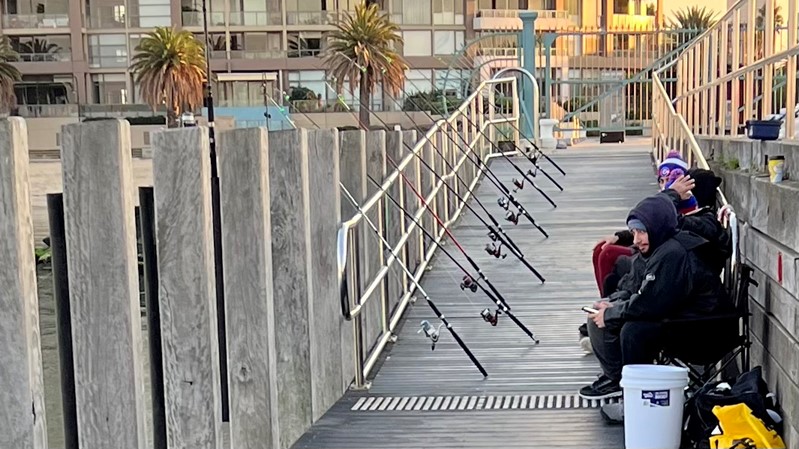
The act of actually catching a fish for most a secondary.

Rain hail or shine, whenever you go for a stroll along our beautiful shoreline you can always be sure to come across people chancing their luck doing a bit of fishing. Whether off piers or rocks in a boat or kaiak, people love the solitude or companionship of sinking a line, sinking a tinny or two when it's hot or a hot thermo cocoa or two when its cold,  just drowning some bait and enjoying the company and serenity of our stunning bayside waters. The act of actually catching a fish for most a secondary to the the pure enjoyment of being out in the fresh air either solo or with friends and family.

So to all the fishing people out there enjoying our waters good luck, enjoy the fishing and…. Please make sure to clean up before you leave.


...more
Promotion
Previously
Promotion
Good MorningImage Caption
The article provides information about activities and events as well as links to relevant third-party websites.
Image Caption


...more
There are good reasons for not implementing this and other road closures

By a concerned Mills Street Resident

Image attribution: Google Image of Herbert-Montague Street and Kerferd Road intersection

There is increasing concern regarding the proposed Shrine-to-Sea Avenue proposed by the Victorian Government in partnership with the City of Port Phillip. Residents are concerned the project may not only divide Port Phillip but also divide the Albert Park locality. The path to Beaconsfield Parade from Kingsway along Albert Street and Kerferd Road is already clearly delineated.  Source

Many residents have voiced their concern that a dedicated path with intersecting side roads blocked off will seriously and permanently create a barrier that will have an effect similar to that which occurred when the enforced Kingsway was forged through the middle of South Melbourne – creating a freeway dividing the then city into two distinct areas with little communication between.

Residents are concerned that the closure at Herbert-Montague Street and Kerferd Road, Albert Park may be the beginning of a series of Council planned closures to implement this divisive community policy. 

The Herbert and Montague Streets closure now appears to be permanent following extensive delays of the trial that started in February 2021, with the traffic data collection. The Council website states  ‘Due to Covid-19 restrictions, we have been unable to record the final traffic data counts and will conduct these as soon as restrictions ease. Until this time the trial will remain in place’. Source

There are good reasons for not implementing this and other road closures:

1. An inconvenient barrier to the Albert Park shopping centre from the east of Kerferd Road and to Middle Park from the Albert Park side.

2. All street closures have negative impact on other surrounding streets by re-directing and increasing traffic in an abnormal pattern. Traffic will be increased on: 

  • a. Canterbury Road
  • b. Hambleton Street
  • c. Richardson Street
  • d. Merton Street
  • e. O’Grady Street
  • f. Little O’Grady Street
  • g. Finlay Street

3. Inhibits community interaction for an ageing population

4. It is not any safer for pedestrians or cyclists

The traffic management solution at Danks Street where it crosses Kerferd Road (see Google image below) has worked well to remove the vehicle danger of the intersection. If prevention of vehicle accidents is the concern, then a similar solution can easily be implemented at the Montague-Herbert Street intersection with Kerferd Road.


...more
Culture
Good MorningImage Caption
The article provides information about activities and events as well as links to relevant third-party websites.
Image Caption


...more
Promotion
CEOs are not elected and control $12 billion our money every year.

By Dean Hurlston, Ratepayers Victoria, Inc. 

It is well established that Council CEOs move around the industry to advance their careers.

The vast majority of Large Council CEOs come from smaller Councils or roles within the local government sector. A review of CEO profiles on LinkedIn shows just how mobile Council Executive staff and CEOs are. They are always on the lookout for larger roles and larger pay packets.

Across Victoria there is an immeasurable talent pool from Private industry , but you will rarely, if ever, see any of the Private sector talent running our 79 Councils.

Local Councils do not have a definition in law that constrains them to rubbish, roads and rates which is what most people expect Councils to deliver on.

The Local Government Sector is awash with CEO’s and Executive staff that are in it for one reason and one reason only – to resume build, and they don’t want competition from the private sector.

When the Local Government Act was updated in 2020, the CEOs and their union (The MAV) took absolute exception to the Minister at the time (Adem Somyurek) inviting ratepayer organisations to make suggestions on what needed to be changed. 

It was no accident, but it was a defining moment.

For me, it was the start of a study of the Local Government Sector and why CEO’s did not want the end user, consumers (residents and ratepayers) being anywhere near the legislative changes.

Many good suggestions made it into the original draft legislation, only to be removed by intense lobbying by the MAV and Council CEOs. Some of the changes sought to address the power imbalance the public has when dealing with the CEO and executive staff.

When power does not want to be accountable and is fastidious in lobbying against any resident and ratepayer protections, you know there is cartel behaviour behind it.

So what is this cartel?

Quite simply CEOs preside over budgets of hundreds of millions of dollars. They also have very high delegated spending limits (some as high as $2M). These delegations mean the CEO can spend this money without ANY accountability. Only if a spend goes over do they need Councillor permission.

There is a long established pattern in Councils (uncovered by the Victorian Auditor General VAGO, and the Ombudsman) of getting around delegated authority limits by breaking spends into smaller amounts to avoid scrutiny. This has been raised for many years by VAGO as a corruption risk, yet still nothing changes.

Further to this, CEOs use Council projects as the money makers to progress their own careers. These projects have slim, rhetoric-based business cases, if at all. They also use large swathes of ratepayers’ money or enormous amounts of borrowings. Either way, it is long known amongst the CEO group that the way to grow your career is to “BUILD STUFF”. CEOs often go to councils where there is a significant build pipeline because this is what motivates them. 

It is of course these projects that build ones resume and career opportunities. 

The boring stuff of council, running an efficient and lean business is absolutely not on the agenda.

Any listed public company director knows that a good CEO is able to do two things – run an efficient and cost-effective business and innovate to drive transformation that better serves its customers or stakeholders. Yet why is this the antithesis of Council CEOs?

Self Interest. If there is one thing all CEOs have learned in the political machinations of Councils, it is of their self-interest. They are not responsible to industry KPI’s, or standards and they can pretty much make anything up as they go. There are horrific stories across the industry of fraud, politicisation, and cost blows outs, but rarely if ever does a CEO get fired. If they find themselves in a position that is untenable, they are easily able to move Councils and leave behind the trail of destruction, for the ratepayers to pay for yet again.

The Council CEO industry is awash with Ego and hubris. They all regularly inform the government and ministers about their views of what needs to happen in the industry and so far we have a government hell bent on protecting the CEO culture instead of holding them accountable.

Let’s be clear here, many Council CEOs wouldn’t last a month in the private sector, accountable to a real board of directors. They don’t have the business acumen to run a lean and efficient organisation.

On the topic of building, we have seen so many communities oppose large projects and offer alternative cheaper models over the years. Every time they have been outmanoeuvred and outsmarted by CEOs and executive groups who have access to top lawyers, top experts and advisors who will do and say anything to defeat well-meaning residents and ratepayers.

This is the dilemma of Councils. A corporation, run by CEOs who do not have to answer Councillors questions, who keep councillors stage managed with only the information they want to share.

CEOs who have unfettered power. CEOs who can hide community grant recipients connected to Councillors. CEOs who can command internal reviews when things go wrong, but nothing changes. CEOs who buy luxury cars to keep mayors happy. CEOs who know that ultimately, they run this show and they call the shots. CEOs who know that building large projects keeps councillors happy too. These projects help their favourite councillors get elected and re-elected. CEOs who know that they can do things politically for Councillors that will keep them in a job. CEOs who can sit on boards and regularly be keynote speakers in businesses that profit from the sector.

CEOs who wouldn’t dare go to the public sector because that would be an impossible transition.

CEOs who know the sector doesn’t hire from outside, so they are always a protected species.

So next time you drive past a Council project worth tens of millions of ratepayer dollars, whether it be a pool, an indoor stadium, a multi-level carpark, a retail precinct, or a new Town Hall, just remember that this is the legacy of Council CEOs. Their only purpose. To build stuff for their resume and continue to grow the ever-ballooning number of staff at their beck and call.

While they are at it, they command salaries of $300,000 - 700,000 per annum. More than our highest paid state politicians, yet the CEOs are not elected and control $12 billion our money every year. 

A Cartel, you bet!

...more
The link takes the viewer to a third-party website listing activities and events in this region.
test test test test
test
...more
Promotion
Good MorningImage Caption
The article provides information about activities and events as well as links to relevant third-party websites.
Image Caption


...more
From the Founder of The Heart Gardening Project

Author Emma Cutting

Hello Lovely Local!, My name is Emma Cutting and I have been a resident of City of Port Phillip for 20 years. I am also the Founder of The Heart Gardening Project, a community initiative that brings humans and nature together through street gardening. We turn barren, undernourished pieces of public land into gardens of wriggling, buzzing beauty for everyone to enjoy (around 70 so far and counting!).

I am writing to let you know (if you didn’t know already!) that the City of Port Phillip’s (CoPP) new draft Nature Strip Guidelines (NSGs) have just been released for community feedback and, if there isn’t a strong community response to change them, these would mean the end of street gardening for the vast majority of residents in the City of Port Phillip.

There are so many issues with this document but the main two are that…
• Tree squares are not allowed to be planted in
• ‘Clearance areas’ are so enormous that only a few plants at the most can be planted in even the hugest of nature strips

Not only that, but CoPP declares that gardens which don’t adhere to the new guidelines are also subject to removal. This means that, again, the vast majority of existing street gardens, many of them decades old, would be subject to removal at council’s whim.

While there is a definite need for updated, clear and safe Nature Strip Guidelines in the City of Port Phillip, CoPP has demonstrated overblown, short-term thinking around the safety of council assets. These new NSGs effectively deny residents the many positives that can come from street gardening including community cohesion, the ability to contribute to the natural beauty of our city and also individually respond to climate change and declining urban biodiversity.

We need to act now and tell our Councillors and Council Officers that this is not good enough. We need these draft NSGs rewritten to be inclusive, researched properly and empowering. Basically, if you love street gardening, are appreciative of your local street gardener, enjoy walking around your local street gardens, think that street gardening is more beneficial than not for your community, think we need more beautiful gardens, believe that increasing biodiversity is important and/or think we need to do more to fight climate change then please do the following…

• Read council guidelines at
  https://haveyoursay.portphillip.vic.gov.au/nature-strip-guidelines 
• Sign the petition at
   https://www.change.org/keepourstreetgardensgrowing 
• Contact your local ward Councillors directly
• Get out and create a street garden!!
• Place the small sign below (or something similar!) in your front window

Thank you! Love Emma

For more info on street gardening:
www.theheartgardeningproject.org.au 

For lots of pics of street gardens: Instagram
@theheartgardeningproject 

Email The Heart Gardening Project at:
info@theheartgardeningproject.org.au


...more
The name Sale, commemorates an Afghan war hero, General Sir Robert Sale, who was killed in battle in 1845.

Sale is the largest city in central Gippsland. It received a substantial boost after the discovery of oil and gas in Bass Strait in1965. Esso built homes for its executives and senior engineers while the Victorian Government’s Housing Commission built houses for the everyday workers. Sale was also and early beneficiary of the Omeo gold rush in the mid 1850s, It retains a number of rather grand heritage hotels, but its railway station has been relocated to the outskirts, robbing the city of its former country town feel.

Sale is north of the junction of the Latrobe and Thomson Rivers which enters into Lake Wellington, a factor which greatly influenced Sale’s early growth. Nearer to the town there is Flooding Creek and various wetlands and morasses.

Pastoral runs were taken up around Flooding Creek in the 1840s. The most prominent run was The Heart being 30,000 acres. In the mid 1840s a blacksmith’s forge and an inn opened at Flooding Creek, and in 1848 a town settlement was surveyed, comprising the two blocks bounded by Raymond Street, MacAlister Street, York Street and McMillan Street. Town lots were sold in 1850, and the name was changed to Sale to commemorate an Afghan war hero, General Sir Robert Sale, who was killed in battle in 1845.
...more